Monday, 4 June 2012

It ain't your granny's bluegrass!

I am officially on summer break, and I graduate in less than a week! No more papers to write or articles to read, and although I'm letting out a sigh of relief, it's followed by a feeling of bittersweet sadness - no more exciting class discussions (in the role as student, of course), no more visits in the TA office, and no more getting paid to read and write stuff that I enjoy.  Though I'm sad to be leaving this time with an awesome group of people, I'm excited for the next step...playing the waiting game after sending out applications, hopefully getting a job soon, and (my favorite part in all this) sitting back to enjoy a little bit of downtime . . .

To kick off the summer, this past weekend my husband and I ventured to Scottown, Oh to our first Appalachian Uprising Music Festival! Even though we were in Ohio, we definitely felt like we'd ventured south, back home to the foothills of Appalachia.  The bluegrass festival was held in a 'grand field' (as Chris Thile from The Punch Brothers called it), where people could camp out between the three days of endless music.  We only stayed Saturday night but we listened to more than 11 hours of bluegrass including music from The Vespers (my new band obsession) and The Punch Brothers (my husband's current favorite).

The road trip there was half the experience, venturing off the beaten path and on to winding country (and sometimes) barely-paved roads.  We took our tent and camped out with the rest of the festival-goers, and spent the day in our folding chairs, eating pulled pork sandwiches, corn on the cob, and fried potatoes on a stick, listening to some awesome bluegrass.  But this wasn't your granny's bluegrass!

I have my husband to thank for introducing me to The Vespers who played a couple acts before The Punch Brothers.  The foursome rocked out with their unique, spiritually-inspired, soul-driven music, bringing people out of their chairs not only to 'flat-foot,' but also bang their heads.  To give you a little taste, here's a video clip I took - the chorus of one of my favorite songs, "Got No Friends."  You can listen to the whole thing here, and watch more of their videos here.

Well I got no friends today, and I wonder if tomorrow will be the same. But I know no matter what I do, Jesus I will always have a friend in you!


Some other highlights from our first 'Appy Up' experience . . .

"Appy Up Ya'll"
. . . venturing off the beaten path . . . 

the camping folk in 'the grand field' of Eden Valley Farm 
our little campsite
The VESPERS performing "Grinnin' in Your Face"

signed merch.
The PUNCH BROTHERS


Wednesday, 30 May 2012

A Different Kind of Memorial Day: Honoring Survivors of the 'Invisible War'

Before I begin this post, (which was adapted from a reading response for one of my classes) I want to preface it by saying that I'm not against American nationalism; rather, I'm against unquestioning, unwavering nationalism.  The post that follows is meant to honor a minority of soldiers who are forgotten and not honored, particularly on Memorial Day...


This week, in our final class of Feminist Theory, we read Cynthia Enloe’s “When Soldiers Rape*.” It was certainly an interesting read, especially considering Memorial Day weekend, when no matter where you go you’ll see signs displaying red, white, and blue, the gloriously bold emblem of the eagle, the reminders to “Thank a Soldier” or “Remember Those Who’ve Fallen.” You see little girls dressed in bandana dresses of red, white, and blue, and hair bows with shining white stars – I had a similar outfit when I was a little girl.  People in my family and my husband's family have served in the military and I grew up celebrating Memorial Day, thinking of my family members and their service to this country.

However, in recent years I’ve grown uncomfortable with the growing unwavering nationalism in this country, a nationalism without critical questioning of this nation’s actions. Particularly in the Christian community, and the nationalism in the Church: the American flag flown higher than the Christian flag, the pledge to the American flag in Bible School (weirdly enough done before the pledge to the Christian flag and the Bible).  I've attended numerous church services and heard people include a grateful tribute to those who’ve fallen for our country in their prayers, comparing it to the blood shed by our Savior for our sins. For me, there’s no greater blasphemy than to compare the two – they are not at all comparable in my mind.  Yes, we should honor those who've gone before us, but they did not die for our salvation.  I see danger in this kind of language, and in these extremely militaristic practices related so closely to the teachings of the Bible.  I believe there is a great danger in the kind of attitude of “serving God and country,” when as Christians we should only serve one master (Matthew 6:24).

What I think is so dangerous about this emboldened nationalism, whether considering the Church or not, is its lack of critical questioning and obedient support. If one decides s/he is against war, people automatically believe him/her to be against soldiers and America. However, people display proud banners and support for their troops, not stopping to consider the negatives of war, soldiers, and the teachings/methods of the military itself. Oftentimes as people enjoy their Memorial Day weekends grilling out, wearing their Old Navy flag t-shirts (I had several of these growing up too) thanking soldiers for their dutiful service, they don’t stop to remember what Enloe discusses: MILITARIZED RAPE, which is becoming more and more prevalent each year.

We need to make another holiday, another Memorial Day if you will, to remember all those victims and survivors of militarized rape, “rape perpetrated by men as soldiers . . . experienced by women in a variety of forms” (508). Particularly, the kinds of “rapes of women in wartime by civilian men of their same ethnic or national community” (509). But currently, there is no special day set aside to consider the negative, ugly side of the military, war, and soldiers, what Enloe calls “misogyny nurtured by and licensed by the militarized climate” (509).

Some might argue this is but a small issue, (in fact I think many would say that) but according to NPR, “a 2003 survey of women using the Veterans Administration health care system [revealed] that 28 percent [of female soldiers] experienced at least one sexual assault during military service**” (Hillard). Indeed, a new documentary is being released soon called The Invisible War, which serves to detail the growing occurrence of female soldiers raped by their fellow “brothers-in-arms.” Even though these small steps might be taken toward publicizing these atrocities, for the most part, as Enloe points out “the women who suffer rape in wartime usually remain faceless...and they are put on the list of war damage...an indistinguishable part of poisonous wartime stew called ‘lootpillageandrape’ [loot pillage and rape]” (508). For the most part these rapes are forgotten.

Source
I would argue that this different kind of Memorial Day would need to have a much different meaning than the one we have named to celebrate and remember those who ‘serve our country and those who have fallen to defend us.’ As Enloe notes, “Shana Swiss and Joan Giller...warn activists who are genuinely concerned about wartime rape not to let their own concern turn into objectification of women as victims” (510). Instead, it might be better to call it “A Day of Empowerment,” a day to remember those women who have “come to feel empowered enough to report when they have been raped,” a day to hope for more empowerment for those who haven’t yet reported it (510).

This country needs to stand up against militarized rape, taking more actions to prevent and punish these atrocities, and develop more critical questioning rather than unwavering nationalism.  We need a different kind of Memorial Day for these soldiers who've experienced Military Sexual Trauma (MST) - A Day of Empowerment.

*Enloe, Cynthia.  "When Soldiers Rape." Feminist Theory: A Reader. Ed. Wendy K. Kolmar and Francis Bartkowski, 2010. Print. 508-16.
**Hillard, Gloria. “Scars of War Run Deep for Many Female Vets.” NPR. 4 Oct 2007. Web. 28 May 2012.

Wednesday, 16 May 2012

Super Tuesday

Yesterday was pretty amazing. . .

First, I got up early and headed to Kroger to purchase a small veggie tray and some honey buns (I realize now what an odd pairing this is).  Then I met up with one of my classmates (K) from my Feminist Theory course.  Together we drove to a local women's shelter/family violence prevention center to participate in a small service-project we put together for our Women's Studies class.

Although we were both very excited (because we would be conducting a creative exploration session, which included writing, creating art, listening/reading poetry) neither of us was very nervous.  I told K that I was afraid we wouldn't be able to do the project after all, thinking we were both intuitively suspecting an unexpected cancellation (I've learned things can fall through last minute with non-profits).  When we found the center I finally felt a wave of nervousness because there were gates and a call box for us to "state our names and reason for visiting."  Inside the gates, we found a parking spot and walked to the visitors' entrance.  Inside, it resembled a dentist's office: chairs and small end tables with magazines and plastic toys and games for children.  We were met with yet another call button, and a friendly-looking woman emerged from behind the window.

She led us to the small room where we would do our activities with the women.  It was perhaps the first time either of us had really thought the women would already be there; they weren't in the room, but they were waking up in the rooms around us, rooms where they were staying temporarily.

We spread out the art supplies (crayons, markers, glitter pens, drawing paper) and small notebooks and pens, putting the snacks on a side table.  In a few minutes the first young woman (appeared to be in her early 20s) entered the room wearing lounge pants, a sweatshirt, and carrying her purse.  Her eyes lit up when she saw the supplies on the table.   She asked if we were going to be doing art; K and I shared a smile and told her we were indeed going to be doing some art - we were hoping to have a great time with them!  She seemed excited and told us most of the visitors just sat and talked to them and they answered questions and such.  We told her we hoped to have some fun with them today, and that K and I would both be participating in all the activities too, drawing and writing along with them.

More women entered the room and we introduced ourselves to one another (most of the women appeared to be in their 20s and 30s, one woman was pregnant, and we later learned that all of them had children - they lovingly shared photos of their children with us!).  In all we had six women in our little class, a perfectly intimate gathering.

We started by tossing a ball of yarn around and sharing our names and our favorite things to do.  In the end, we each held a piece of the yarn, connected by the web it made around the table.  Then, K led us in a creative visualization, taking us through "the house of our senses," traveling through the rooms of sight, smell, taste, touch, and smell.

Next, I read a poem called "The Invitation" aloud and then we passed it around so the women could choose a stanza that spoke to them.  They spent the next half hour creating a piece of art from the poem, using the words or images that spoke to them.  What was so neat about this activity was that one of the workers at the center said they could have a smoke/bathroom break and only one woman got up to use the restroom.  They said they'd rather stay there coloring and drawing!

After the break, we all wrote a letter about a day five years into the future, addressing it to either (1) our future selves or (2) someone else who would be proud of our accomplishments  We wrote about our ideal day, what we would be doing, who we would be with, why it would be "ideal," and what we would have to overcome to be there.  The women really seemed to enjoy this activity and a couple shared their writing with us.  They all said they would like to continue writing because they thought it was comforting and made them feel hopeful.  They each left with their notebooks and some art supplies.

After the session was over, K and I stuck around talking to some of the women; one woman let me hold her baby!  They said we should come back and visit them, and I know we're both interested in returning sometime soon, even if just to visit.  This experience was so unbelievable to me, and I can't believe how at ease I felt there.  Normally I think I would have felt anxious or nervous, but I felt so comfortable spending time with the women there.

When K and I returned to the car, we tried to process the experience together, considering how we felt and how it affected us.  We both had other things to go to that day so we were forced to move on quickly, but that experience will stay with me forever.  I hope we can go back again sometime soon!


Less than two hours after our session was over I had my creative nonfiction class to attend at school.  It wasn't an ordinary class, however - Joyce Dyer, a writer who resides in Akron, OH was visiting our class.  We read some of her stories for homework so I was excited to hear her talk to us about the reflective voice.  What I didn't know was that she identifies as an Appalachian because her parents moved to northern Appalachia when she was little and she grew up in a mining family.  When I got to class, one of my classmates handed me a book called, Bloodroot: Reflections on Place By Appalachian Women Writers, edited by Joyce Dyer.  I was so excited!! My professor had gotten it for me!

I sat and listened with the rest of the class as Dyer talked to us about reflective voice, showing us examples from other CNF writers, anxiously anticipating when I could go up and talk to her after class.  When class was over, I walked up to the front and told her I enjoyed her talk and that I was wondering if she could sign my book.  My classmate and professor had already told her about me (!) and so she asked me questions about what part of Appalachia I was from (pronouncing the same way we do in southern Appalachia) and signing my book.  She also told me about an Appalachian Writers Workshop in Kentucky.  If I had thought of it and known ahead of time I would've mentioned that I've studied with Rita Quillen, an Appalachian poet included in Bloodroot.  We said our goodbyes and I carried my signed book, admiring it in the hall.


I knew when I woke up Tuesday that my planner was packed full of stuff to do.  But I didn't know what a great day it would be.  Enough of that. . . here are some pictures!

Our art supplies! 
Showing off their drawings :)


My "drawing" of words that spoke to me in the poem
All their beautiful artwork
Bloodroot. . . I just love the cover!
She signed, "I'm so glad I met a fellow Appalachian. I hope to see you again."

Sunday, 13 May 2012

A Hepburn Saturday

Yesterday Scott and I caught some Katharine Hepburn films on TCM.  They were celebrating what would have been her 105th birthday with Bringing Up Baby, Guess Who's Coming To Dinner, and Adam's Rib.  We also watched the documentary film she made when she was in her 80s after writing her autobiography All About Me.

I didn't know much about Katharine Hepburn before watching her documentary except that I thought she had an eccentric-sounding voice, and I loved watching her in On Golden Pond when I was a child.  But I learned that she was quite a spitfire (especially in her old age), a very independent woman, and interestingly enough her mother was a suffragette.

I really want to read her autobiography after having watched the documentary that inspired it.  She led a full life, making films and traveling, and the title of her book All About Me, certainly seems to say a lot about her personality.  She admitted about herself that she loved showing off for as long as she could remember, and she lived by this quote:

Source: google.com  


Source: sodahead.com 

We ended our Saturday with another film. . . The Avengers at the drive-in, our first drive-in experience as a married couple living in Ohio.  We went several times when we were dating and living back in Virginia, but this was certainly an experience!  They packed in the cars two between each pole and there were two screens showing different movies.  Other than that it was similar to our drive-in at home (minus the sound echoing off the mountain wall). 


The Dixie Twin Drive-In  - - I love this old sign 
Our large bag of movie popcorn:
no, we didn't eat it all in one sitting (although that would've been the case without some self-discipline YUM)


Saturday, 12 May 2012

"Confronted by Someone Else's Story"

I'm pulling from the archive today, republishing an old post from last year because of its relevancy.  Yesterday's post, "Thoughts on Amendment One and Christians," referenced Rachel Held Evans' blog post about the culture war being waged by groups of Christians against gay marriage and LGBT concerns.  Today, her post was equally powerful (if not more so), contemplating what it means that so many of us as Christians agree that we're ready to move from "waging war to washing feet," to praying for guidance and healing.  And even though others close to us may disapprove of us taking part in this conversation (at all), we need to understand that we're not alone in our individual journeys (wherever that may be on the spectrum).  Indeed, I think it's important that we meet each other on these journeys and learn to have loving conversations, rather than hateful confrontations.

Today's post emphasized the importance of stories.  Evans writes, 

We need to listen to one another’s stories. Time and time again, I talk to Christians whose experiences, like mine, go something like this: 


“I used to think that homosexuality was a sinful, promiscuous lifestyle that people chose in rebellion to God, and that Christians need to rally against the ‘gay agenda’ through legislative action. Then, my best friend (or brother or sister or son or daughter or high school buddy or neighbor or mentor) came out, and everything changed. Their story didn’t fit the stereotype. It didn’t fit into my previous categories. Their story made me see that things aren’t that simple, and that the ‘war’ between Christianity and homosexuality represents a false dichotomy that is incredibly painful and destructive to Christians with same-sex attractions. After that, I could no longer support the sort of rhetoric and actions that only serve to make this world a more hostile and hopeless place to the ones I loved. I kept thinking about all the depression, all the suicides, all the secrets. I just can’t support a culture that, perhaps inadvertently, fosters that.” 


Everything changes when you are confronted with someone else’s story (Source).

As I commented on Evans' blog, "I like that you've emphasized the importance of listening to others' stories. I am a 23-year-old Christian who grew up southern Baptist, raised to think homosexuality is a sin. Then I went to college and met gay and lesbian individuals whom I grew to love, listening to their stories and becoming 'torn' on the issue [she references a book called Torn: Rescuing the Gospel from Gay- vs. Christians Debate]. Then I went to grad school and met (and read) even more gay and lesbian individuals, who were also Christians.  I began reading Sara Miles' Take This Bread with my husband, reading Jennifer Finney Boylan's She's Not There, (perhaps what changed my mind more than anything), going to a talk by Jennifer Knapp (a lesbian Christian singer/songwriter), having conversations with other Christians about the 'issue,' and I've now evolved to call myself a Christian ally, supporting the LGBT community and fighting against the kind of prejudice and hatred you discussed in your last post. I'm very much looking forward to following what unfolds here, listening to more stories, and learning better ways to deal with situations like you faced with your husband (I deal with this. . . and I oftentimes have to 'hide' my own opinions just to keep the peace). I know there are so many of us who still do this, sadly - faced with situations where the LGBT community is being attacked without any hope for defense. Thank you for sharing and letting us all know we're not alone!"

Again, I agree with Evans that the stories are what need to be shared, because, as she says, "Everything changes when you are confronted with someone else’s story."  What follows is a post I wrote a year ago while taking Feminist Memoir.  I haven't changed anything because I think it's interesting (for myself at least) to see my growth and change even in a year's time, but also how this experience still shapes my worldview as a Christian. . .*would love to hear more from readers - what stories do you have to share?


This past week was both challenging and eye-opening.  Challenging, because it had come time to begin the final book for our Feminist Memoir class, and it dealt with transgender issues.  I'll admit I was close-minded about beginning my reading, and most of this can be blamed on my ignorance of the issue.  I read Jennifer (formerly James) Finney Boylan's She's Not There: A Life in Two Genders and quite literally, couldn't put it down.  I slowly learned what it means to be transgender, and for her specifically, it meant not ever truly feeling like she belonged in her own skin.  She would watch her mother iron her father's shirts, becoming frustrated when her mother would point out that she would wear shirts like these one day.  She was a young girl, trapped in a male body for much of her life, and remembers feeling this way at the early age of three.

This week was eye-opening because I learned so much about transgender issues through the story of one person.  I got to meet her in person on Thursday, sharing pizza and discussion, and then listening to her lecture later that day.  What amazes me the most about her story is that she lived most her life as a man haunted by the wish to be a woman. 

She married and had two boys before, at the age of 40, beginning the process of transitioning into a female body...and her heterosexual wife is still with her today. Her wife (named "Grace" in her book) is with her through every step of the process, and although there are times of utter frustration and heartache, they share a life together, raising two boys who equally love their "Maddie" (a term they coined as young boys, combining "mommy" and "daddy").  If their family is not a prime example of love, I'm not sure what is.  And what touched me the most about her lecture was when she pointed out that many people may feel that their relationship is "weird," but how many other relationships/marriages are filled with abuse and neglect, etc.? Yet Jennifer and Grace's love is unconditional, which is more than a lot of people can say for their own relationships (I wish I could remember exactly how she said it, because it was much more eloquent than that).

So, I wanted to share this experience with you - my own "transition," if you will - and suggest that when you go into something close-minded, you may very well come out on the other side changed, with wide eyes open, as I have this week.  It's extremely easy to judge because of ignorance and misunderstanding, but as Jennifer's Christian mother (who she says is her #1 fan) pointed out,


"You can't hate someone when you've heard their story."

Thursday, 10 May 2012

Thoughts on Amendment One and Christians

Yesterday two major political steps were taken with regards to same-sex marriage: North Carolina approved Amendment One and President Obama gave his support of same-sex marriage.  I watched as my Facebook feed filled with the following images (which were somewhat expected):


And then several times I saw the following images, paired with people's commentary on Christian's hatred and 'idiocy' about gay marriage and homosexuality.  


The Devon Park Church sign (above) was circulating, along with the commentary: "that's some kind of threesome."  In these moments, I was appalled and became very frustrated! People are no longer making this political war one of left-wing vs. right-wing or conservative vs. liberal, but of Christians vs. gay marriage equality.  I wanted to stand up for those of us who don't at all share or support (and indeed fight) this hatred toward the LGBT community, and say, "We're not ALL like this!" 

While I'm aware that there's definitely reason to have these feelings toward the Christian community, what people need to understand is that many of us don't even see eye-to-eye on this "issue" (I put this in quotes because it's not merely just an 'issue' really - see more below) and there's a great dissent about how this is handled within the Church.  

Because I'm not as eloquent, and because perhaps what I feel has already been said perfectly, I want to direct you to a blog post by Rachel Held Evans, a Christian writer and blogger, whose newest book is called A Year of Biblical Womanhood.

Her post is titled "How to Win a Culture War and Lose a Generation," and it really resonated with me.  It provides an overview of what Christians and others are saying in regards to Amendment One.  But my favorite section of her post is as follows:

"My generation is tired of the culture wars. We are tired of fighting, tired of vain efforts to advance the Kingdom through politics and power, tired of drawing lines in the sand, tired of being known for what we are against, not what we are for. 


And when it comes to homosexuality, we no longer think in the black-[and]-white categories of the generations before ours. We know too many wonderful people from the LGBT community to consider homosexuality a mere 'issue.' These are people, and they are our friends. When they tell us that something hurts them, we listen. And Amendment One hurts like hell...

So my question for those evangelicals leading the charge in the culture wars is this: Is it worth it? 


Is a political 'victory' really worth losing millions more young people to cynicism regarding the Church? 


Is a political 'victory' worth further alienating people who identify as LGBT? 


Is a political 'victory' worth perpetuating the idea that evangelical Christians are at war with gays and lesbians?


And is a political 'victory' worth drowning out that quiet but persistent internal voice that asks—what if we get this wrong?" (Source).

Monday, 7 May 2012

Studying = Attention = Better Prayer

Academic work is one of those fields containing a pearl so precious that it is worthwhile to sell all our possessions, keeping nothing for ourselves, in order to be able to acquire it.  - - Simone Weil

I first read about Simone Weil's concept in this blog post called "Simone Weil on Study and Prayer."  I have since read the essay this blogger refers to, which comes from Weil's work Waiting for God.  To provide some biographical and historical context, "Weil was born in Paris and died in Ashford, England.  [She was a] religious philosopher, essayist, dramatist, and poet, as well as social critic and political activist."*
Source
In her essay, "Reflections on the Right Use of School Studies with a View to the Love of God," she contemplates how 'school studies' and 'academic work,' when done attentively, can "increase the power of attention with a view to prayer" (59).  This is certainly good news for those of us who spend most of our time reading and studying for school.  I oftentimes feel quite guilty reading literature and feminist theory rather than spending that time reading the Bible or devotions.  But, I don't think Weil is saying that's not important either; rather, she makes room for the notion that "in every school exercise there is a special way of waiting upon truth, setting our hearts upon it, yet not allowing ourselves to go out in search of it" (63).

What I found most interesting about this short essay, was her assertion that we should "contemplate attentively and slowly each school task in which we have failed, seeing how unpleasing and second rate it is, without seeking any excuse or overlooking any mistake. . . trying to get down to the origin of each fault" (60).  In this way, she adds, it is "perhaps even more useful to contemplate our stupidity than our sin" (60).  Furthermore, "when we force ourselves to fix the gaze, not only of our eyes but of our souls, upon a school exercise in which we have failed through sheer stupidity, a sense of our mediocrity is borne in upon us with irresistible evidence" (60).

It's interesting to read her commentary on the difference between those who have chosen academia as their field of interest and those who have not (but we must consider her historical context here):

"Happy are those who pass their adolescence and youth in developing this power of attention.  No doubt they are no nearer the goodness than their brothers [and sisters] working in fields and factories.  They are near in a different way. . . [W]orkmen [and women] possess a nearness to God of incomparable savor which is found in the depths of poverty, in the absence of social consideration and in the endurance of long drawn-out sufferings" (64).

Lastly, I appreciated her connection of academic studies to loving thy neighbor: "paradoxical as it may seem, a Latin prose or a geometry problem, even though they are done wrong, may be of great service one day, provided we devote the right kind of effort [and attention] to them.  Should the occasion arise, they can one day make us better able to give someone in affliction the help required to save him, at the supreme moment of need" (65).  This might seem an unlikely connection, but she argues that loving thy neighbor "means being able to say to him [or her]: 'What are you going through?'. . . this way of looking is first of all attentive.  The soul empties itself of all its own contents in order to receive into itself the being it is looking at, just as he is, in all his truth.  Only he who is capable of attention can do this" (64-5).

Right now, for some of us, our school work and academic year is drawing to a close.  We've given our attention to school work and study, some of which we might not have understood or seen as helpful.  But if we remember Weil's analysis in these moments of struggle in academic work, we can learn to be more attentive, prayerful, and loving to those around us.

*Back cover of Waiting for God

Sunday, 6 May 2012

Black Feminist Thought and The Help

Not too long ago I wrote a post called "Wrestling with The Help," realizing and contemplating the ways the film and book have been critiqued by the black community.  I have since continued thinking and 'wrestling' with it, and talking with others about their opinions.  What follows is a response for my feminist theory class, one that I wrote after reading Patricia Hill Collins' "The Politics of Black Feminist Thought" and several other articles concerning Black Feminist Theory.  Since there was such a great discussion that followed my last post on The Help, I thought I'd share this response for further conversation. . .

While reading Patricia Hill Collins’ piece “The Politics of Black Feminist Thought,” I was reminded of the recent controversy over Katherine Stockett’s book The Help and the movie released last August. The book and film depict, through a particular perspective, racism of Jackson, Mississippi during the early 1960s. Skeeter, a young white woman has just returned home from college and begins writing the stories of “the help,” hoping to become a ‘serious’ writer. Aibileen and Minnie are two of the black domestics who share their stories of raising white children and experiencing the oppressive roles as hired domestics, working for small wages and little respect.

As a young white woman myself, I read the book and watched the film, touched at the depiction of the black women caring for the white children like they are their own; for me, Aibileen is the real protagonist. I thought, naively, that the film and book had both portrayed the story of these women in a historically accurate way. However, I started reading articles and blog posts arguing that The Help depicted unrealistic and nostalgic images of the real race issues in the 1960s south, and I began to see that the black community was not nearly as receptive as the white community.

It soon became eerily reminiscent of what Collins asserts as “[s]uppressing the knowledge produced by any oppressed group mak[ing] it easier for dominant groups to rule because the seeming absence of an independent consciousness in the oppressed can be taken to mean that subordinate groups willingly collaborate in their own victimization” (52). I began to worry that the book and film did not fully articulate the complex intersectionality; instead as Trina Grillo writes, “sometimes the governing paradigms which have structured all or our lives are so powerful that we can think we are doing progressive work, dismantling the structures of racism and other oppressions, when in fact we are reinforcing the paradigms” (30). In other words, I started wondering whether The Help was dismantling or reinforcing racism and the oppression of domestic workers.

I watched a segment about The Help on Melissa Harris-Perry’s show on MSNBC, called “The Help doesn’t ‘help’ domestic workers.” Harris-Perry and guests’ criticisms of the film connect to Collins’ discussion of the “suppression of black feminist thought,” which “has been structured along three interdependent dimensions” (53). These dimensions include women’s labor, political mistreatment, and “the controlling images of Black women” (53). The controversy over The Help touches on two of these three dimensions specifically – women’s labor and the stereotypical images of Black women.

Source
First, Collins writes, “the exploitation of Black women’s labor – the ‘iron pots and kettles’ symbolizing Black women’s longstanding ghettoization in service occupations – represents the economic dimension of oppression” (53). One of the arguments against the film and book is that it only depicts Black women as domestics, unable to do anything else other than clean, cook, and take care of white babies. While this might be a historically accurate depiction of the south in the 1960s, it is perhaps one reason why the black community was so angry with the book and film; it is a contemporary depiction of women in exploitative roles that are represented in a somewhat nostalgic way.

Another dimension the controversy touched on – as well as Melissa Harris-Perry’s segment – is the “nexus of negative stereotypical images applied to African-American women” (53). Collins writes, “From the mammies, Jezebels, and breeder women of slavery to the smiling Aunt Jemimas on pancake mix boxes, ubiquitous Black prostitutes and ever-present welfare mothers of contemporary popular culture [these] negative [...] images [...] have been fundamental to Black women’s oppression” (53). Harris-Perry specifically mentions the danger of the depiction of black women in The Help, similar to what Collins asserts, as a way “to keep African-American women in an assigned, subordinate place” (53).
Source
To articulate this connection of the women’s roles in The Help and the dangerous stereotypical images connected to slavery, Harris-Perry suggested that viewers not only read the book and watch the film to form their own opinions, but also read Clinging to Mammy: The Faithful Slave in 20th Century America, by University of Connecticut professor Micki McElya, who argues, “Assertions of black people's contentment with servitude alleviated white fears while reinforcing racial hierarchy” (Google Books). Collins also mentions this reinforcement of hierarchy in her article: “Black women’s exclusion from positions of power within mainstream institutions has led to the elevation of elite white male ideas and interests and the corresponding suppression of Black women’s ideas and interests...” (53).

What I’ve learned as a young white woman after reading The Help, criticisms of the book and film, and Collins’ piece is that we must be receptive of these issues and how they might differ based on our own identities and experiences. Because members of the black community feel that The Help is a contemporary example of “economic exploitation” for Black women and a continuation of “negative stereotypes,” we must openly try to understand these arguments and why they are important in shaping and affecting our current culture and society.

Still, I see where the film and book can point out – even in small ways – the very injustices the black community wishes to bring to light. For example, in the film Skeeter tells her editor, “These colored women raise white children and in twenty years those children become the boss. We love them and they love us, but they can’t even use the toilets in our houses...” (The Help). Even though the film does have its many flaws and historical inaccuracies, I find moments like this, pointing to Maria Stewart’s own “object[ion] to the injustice of this situation: ‘We have pursued in shadow, they have obtained the substance; we have performed the labor, they have received the profits; we have planted the vines, they have eaten the fruits of them’” (qtd. in Collins 51). The lines from the film also point to what Collins calls Black women’s roles as “outsiders-within,” which “allowed African-American women to see the white elites [...from] a special Black women’s perspective” (56). Though The Help has its many flaws, and as a white woman I cannot fully understand, I can see how it can become a useful place for conversation about important race, class, and gender issues.

Thursday, 3 May 2012

Winding Roads and Clotheslines

So here's another short creative nonfiction piece I composed for our class blog. I said I'd wait till class was over but what the heck? I'll go ahead and share them as I go!

Source
It’s my dad’s birthday so my husband and I are meeting my parents and brother at our designated halfway point between home in Ohio and home in Virginia – Lexington exit 108. The same exit my husband had to take when he did his master's at Asbury. Every two weeks that first year he’d speed the three hours home, praying that he wouldn’t get caught behind a slow coal truck. It’d be a Friday night and I’d get off from play practice around 11:00 and head down the valley to his parents’ house, praying I wouldn’t hit a deer on the winding mountain road.

Those weeks seemed to drag along but Sunday afternoons came too fast. I’d drive through tears back up the mountain, watching his bumper in front of me, wiping my eyes so I could see. I’d drive him out of town, watching him leave the state, leave me, knowing he’d come take me away one day.

Six and a half years later and we’re married - no more winding roads, they're straight ahead for miles, stretching along fields and towns.  Our friends and family call us‘city folk’ now, living in Dayton proper where we hear sirens and cars and people nonstop.  When we drive home to Virginia it takes a while for our eyes to adjust to the pure darkness, we’ve grown used to the streetlights. But we can’t get away from them. Can’t get away from the noise, the constant movement, the constant pulse.

And here’s the part where people who’ve lived here their whole lives laugh because they would never call Dayton a ‘city’ or ‘city-esque,’ or maybe they would. I guess it depends who you ask. I sometimes feel like I’m a hamster on a wheel, driving I-675 every day to Fairborn, then Centerville, then back to Dayton, school, work, play.

. . .

We’ve made it to Lexington, met up with Mom, Dad, and my brother, we’ve eaten, visited, watched a movie, walked around a mall, not wanting to say goodbye. But we’ll see each other in another month, we remind ourselves. It won’t be like this last time when we’ve gone from Christmas to April.
It’s time to give the hugs and air kisses, the goodbyes till next time. And here it comes, the part that makes my gut knot, makes me glad we’re driving home in the dark so I can wipe at my eyes and not feel embarrassed.

“You take care of yourselves. Be careful up there,” Dad says, pulling me tighter into the hug. And I know he’s seeing that 8-lane road I drive everyday. I know he thinks about it more than he should. I know the image comes up in his mind when he’s spraying down the dusty coal road on his job.

This seems silly to some, but not to people who went nearly their whole lives driving on two- and four-lane roads. Even when we’d travel south for vacation in Myrtle Beach we were on safe four-lanes, comforting trees on either side.

We’re being called back there, pulled home. My husband's fed up with driving altogether and I tell him he could never do what I do everyday, merging and changing lanes, moving with the rest of the world to the places we're all going. I've become the city-driver and I critique him when we're out together. He's in the driver seat and he awkwardly changes lanes, waits for a green arrow, "You could've gone just now," I say as it turns red.

But then I've always critiqued his driving; the first time he took me home from play practice we sat at the light together, looking at each other's lips. I saw the light change out of the corner of my eye and said, "It's green, you can go." He laughed at me; this 15-year-old telling him how to drive. I didn't even have my learners' but I wanted to be the boss. He says he should have known a lot about me in that moment.

He jokes about getting a horse to ride to school everyday. I picture this in my head, they could put him a tie-post next to the Liberal Arts building and he could carry out a bowl of water between classes. He’s resigned to walking to work for now, but I know he’s not really joking about the horse. He told me the other day he wants to buy some birdseed to have in his pocket on his way to school; he can feed the birds like Francis. I think of the picture I bought him for Christmas - a black and white carving of a modern St. Francis in jeans and t-shirt, birds on his shoulders. I draw the line when he says he wants to start walking barefoot.

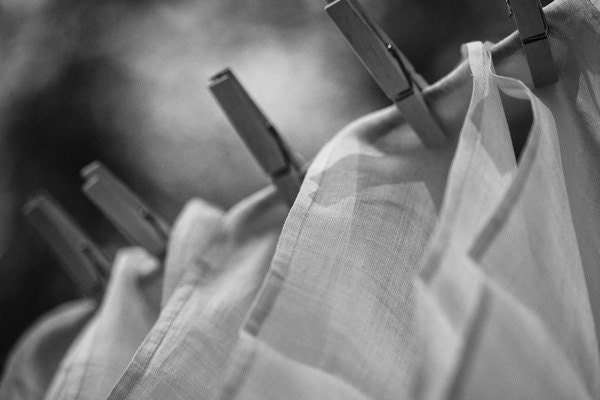
I can't be too hard on him though. I've recently discovered the spiritual significance of hanging clothes on a line. My favorite writer describes this simple physical act: "After a day of too much information about almost everything, there is such a blessed relief in the weight of wet clothes...Every time I bend down to shake loose a piece of laundry, I smell the grass. I smell the sun. Above all, I smell the clean laundry. This is something concrete that I have accomplished..."

Source
I've started hanging laundry out on our small balcony, hoping I can exchange the smell of fresh grass with potted plants.  It'll do for now, until we have land and our own clothesline in the grass.

Our 22- and 17-year-old selves shake their heads and say, “What the hell are you two talking about?” “People can change,” we say defensively. We’ve seen enough of the city, we need the trees, the mountains, the quiet. We need to look up at the night sky and see the stars. We need those winding roads, the coal truck that might slow us down.

Wednesday, 2 May 2012

The Bird Feeder

So...I promise I've not dropped off the face of the earth or anything (although it has felt like that just a little bit).  I've been finishing my independent paper for my MA portfolio and I'm excited to say that it's finished and I turned it in yesterday!!! I don't know if I've ever been that excited to turn in a paper.

Anyway...since I've not had time to write on here I thought I'd share a short creative nonfiction piece that I composed for our class blog.  It's called "The Bird Feeder"...enjoy :)

My husband bought me a bird feeder this year for Valentine’s Day. I know some people might think that seems like a gift you’d give your seventy-year-old grandmother to hang on her porch so she could watch the birds while she sits in her rocking chair, but I thought the gift was terribly romantic. My husband and I are usually found doing the activities of elders anyway – Sunday matinees, James Taylor and Carol King concerts, or browsing antique shops – so it makes perfect sense if you were to make that comparison.

The bird feeder has a forest green top and a base that provides railing for the birds to perch and enjoy their meal. The base also has a couple small attachments that look almost like leaves where the birds can sit with a little more room if they so choose. The seed itself is packed tight into a large cylinder which can be changed out every few months or so. I’d never really seen a feeder quite this big before, but then again I’ve never been much of a bird feeder connoisseur.

Since he gave it to me in February we’ve only recently begun sighting birds. What we didn’t suspect was the amount of birdseed they’d drop onto our balcony and our railing; they sure are messy little things.
Cleaning up the mess they've left
A pair having their breakfast - I can't seem to catch a pic of them when they're eating from the feeder
We’ve been entertained not only by the birds themselves, but also with our cats’ fascination with them; they could sit for hours, watching them out the window. Although sometimes they get the dire urge to pounce, smacking their heads against the glass window – one reason we’ve tried to leave the door open for them. The screen’s not nearly is solid.

Last year they spent endless summer days chasing down wasps that would come in through the small holes in the screen door; we’d find groups of wasps lying dead on the carpet. I can just imagine my husband, ever the softy for all God’s creatures, saying a short prayer for them as he scooped them up in his hand and tossed their small bodies into the pots of dirt on our porch, to dust we shall return.

This year I’m sure Sammy and Sophie would similarly love to get their paws on those little birds – becoming rounder by the day, I might add – but they’ll be stuck on the other side of the screen door, contained from their natural instincts to chase them outside. Sophie will have to continue making her birdy sounds within the confines of our apartment, and Sammy will take it all much better – choosing to nap on the couch to keep his mind off it all. I can just imagine Sophie sitting attentively at the door, poised to strike but for the screen in her way, looking back at Sammy asleep on the couch, “We should have left those damn wasps alone.”

Thursday, 19 April 2012

Obsessions

ob-ses-sion (noun): 1: a persistent disturbing preoccupation with an often unreasonable idea or feeling; broadly : compelling motivation 2 : something that causes an obsession


 Our first day of the CNF writing class our professor had us go around and introduce ourselves, and 'confess' two of our obsessions.  I thought this was brilliant for a creative writing class, but it could also be a great way to break the ice in any class! As we went around sharing our current obsessions, we learned a lot about each other's interests, backgrounds, and personalities.

One girl shared that she was obsessed with buying movies and owns more than 1,000 of them; another girl said she's been obsessed with Titanic since it came out when she was in middle-school (I could definitely relate); several of us admitted that we were currently obsessed with The Hunger Games
, and we jokingly remarked that we need to have a small group discussion one day - it's yet to happen but I don't doubt that it might one day.


Sharing our obsessions got me thinking about my own strange obsessions I've had over the years.  I think it would be an interesting thing to explore in writing some time.  I've tried to think of some of the things I've gotten hung-up on for a period of time growing up, and I found that most of these obsessions came about because of a movie:

Source: sharetv.org via Jade on Pinterest

Storm Chasers - - I loved Twister and went around 'chasing' them in the backyard with my own 'Dorothy' I'd made from a plastic play grocery store cart, balls of paper, and the little whirligigs that blow in the wind.  One year for Christmas Santa Claus brought me Tornados, Hurricanes, and Thunderstorms videos from The Weather Channel.  I've watched almost all the movies made about tornados (that seemed to be my favorite storm to chase).


The Home Alone movies - - I was Kevin. I wanted a brown backpack like him to carry the TalkBoy I got for a birthday (or Christmas, can't remember). I had Mom record things he said into my TalkBoy ("...and I want one of those little refrigerators you have to open with a key.  Credit card, you got it!").  This is perhaps the weirdest obsession in my mind, and I can't really figure out why I was so interested.

Titanic - - I already talked about this in a recent post; I loved the 1997 film and started exploring the real Titanic, checking out books at the library, watching the old films of the tragedy, typing up facts about the people and the things onboard on our little computer and printing them out.

I'm sure there were many more in between if I really sit and think about it, but when I was older I was obsessed with more literature-related stuff:


Transcendentalists and the American Bloomsbury - - Writers who lived in Concord, Massachusetts - Louisa May Alcott, Ralph Waldo Emerson, Margaret Fuller, Nathaniel Hawthorne, Henry David Thoreau. I thought it was so interesting that they all lived close to one another and had relationships, such brilliance living in one area.  When I was a sophomore in college my parents took our vacation in Concord and my mom and I got to tour the Alcott house; we visited Walden Pond where Thoreau lived for a while and wrote Walden; we saw Hawthorne's and Emerson's houses.  I am so thankful that my family took the time to do this, because goodness knows they weren't that interested in it except that it was part of American history and it's quite beautiful up there.

Holocaust Literature - - Another tragedy to add to Titanic and Tornadoes, I've been interested in Holocaust literature since college and can probably call this an ongoing obsession. I think it first started around the time I was in a play about children in the Holocaust called I Never Saw Another Butterfly.  I never got to take a Holocaust Lit class (though they offered one...bummer), but I've researched it a lot on my own and written papers since then.  I have a growing list of related books and I'd eventually love to build a class centered around Holocaust Lit.  I find it fascinating that what these people - who were days and months from their death, threatened with being exterminated, or those who lived and survived - wanted to do was write and create art.   The children in Terezin wrote and drew on the back of Nazi paper; they could turn it over and find the list of people who were dying around them. If that isn't powerful and if those words don't tell us something, then I don't know if there is really power in anything. "A Wall of Two" is a collection of poetry written by two sisters in a concentration camp; they sewed the words into their clothes and they live on today. Anne Frank's words live on. These victims of humanity survived through the words they left. Those words are read today. They live through those words. Their words will last forever (or as long as someone finds the need to pass them on).  I just find that amazing.

The Hunger Games - - Again, a very recent and current obsession.  Anytime I hear someone talking about it I join the conversation.  I know many people think it's a bit morbid (and it is) but it's a powerful story and metaphor for our world, providing a place to begin discussion about oppression, subversive living, and class structures.

It's interesting to think about our obsessions; they tell a lot about our personalities and experiences, and they help us explore the stages we've gone through.  Our obsessions shape us and stay with us for the rest of our lives. What obsessions did you have growing up or do you have now?

*from Merriam-Webster dictionary online

Tuesday, 17 April 2012

Titanic: The Final Word

When the feature film Titanic came out I was in middle school, that nerdy stage where you're sensitive to most everything.  I loved the film and started checking out books, magazines, and old movies about the Titanic from the library.  My grandparents subscribed to National Geographic so I could get the special edition book about the Titanic exhibitions (and I still have it at home).  I bought the Titanic Original soundtrack, the board game (yes, there's a board game, and it has nothing to do with the movie) and the 'Back to Titanic' soundtrack.  
Titanic (1997) Source
This wasn't the first movie/event that I had become a little obsessed about, and it certainly wasn't the last. Even when I graduated from college only a couple years ago, my parents took my husband, brother, and me to the Titanic museum in Pigeon Forge (and I have to say I was pretty giddy about it). Though I'm not still stuck on Titanic, it will always have a special place in my heart because of those memories I have of learning and connecting to the tragedy as a young, nerdy middle-schooler.  I've met a fellow Titanic-lover in my CNF class (although I think she's still very much attached to the story and is trying to explore her attachment in one of her creative essays).
A Night to Remember (1958) Source
I haven't gone to see the 1997 movie re-released in 3-D, frankly because I'm not that into 3-D movies.  My husband and I did catch about half of James Cameron's documentary The Titanic: The Final Word.  Because I'd watched the old films made about Titanic in the 1940s-50s - ones that didn't even show the boat breaking in half because they didn't believe the eye-witness accounts and hadn't yet found the wreckage underwater - I wasn't too surprised that thanks to more recent trips to the wreckage, they've figured out even more about how it sank.  James Cameron and others working on the mission now see that the depiction in the feature film is incorrect.  I think this is fascinating though - another movie made and proven to be wrong.  Though they say they've figured out exactly how it went down now, I think it's safe to say we might never truly know, or else we're giving in to the very hubris over nature that caused the tragedy in the first place.


I particularly enjoyed the last few minutes of the documentary - Cameron compared the Titanic to our society today, "it's a perfect little encapsulation of the world and all social spectrum..."  I thought it was pretty brilliant how he discussed our own 'full-speed-ahead' mindset that will always affect the steerage (the poor) the most, while the wealthy will always have access to necessities and means of survival.  I can't explain it quite as eloquently as he did so I'll just direct you to a transcript of the final two minutes of the documentary (my favorite part). And here's a short video that shows the main points of the film.   

Monday, 16 April 2012

Writing Too Much Elsewhere...

I've been writing so much for school these past few days I've not had time (or energy) or anything left to say on here.  I've been enjoying the writing for creative non-fiction, especially getting the chance to share drafts with classmates, getting feedback, and reading what other people have written.  Our class has our own blog where we have to post short writings, describing the simple moments in our days to practice writing about our life.  It's been fun reading about other people's small moments and having to pay close attention for moments to write about! I might share a couple on here when the class is finished.

This week I have to lead the class in a writing exercise and I've chosen to do something connected to the body, after taking Writing the Body last quarter.  We've not really read anything from the assigned readings about the body (or at least I've not been paying attention to that aspect when we've been reading) so I went back to some favorite memoirs to find examples for class.  My favorite writer at the moment, Barbara Brown Taylor, writes quite a bit about the body in An Altar in the World so I'm going to take in a few quotes as examples.

I thought since I have nothing else to say I'll just leave you with some of these quotes, because they're great.

"Our bodies have shaped our views of the world, just as the world has shaped our views of our bodies.  Each of us has a unique body 'signature,' which consists not only of our distinctive physical characteristics but also of our posture, gait, our way of using our hands.  The moment I come into a room, you can tell that I was 5'10'' in the eighth grade.  All these years later, it is still difficult for me to stand up straight. To square my shoulders requires an act of conscious will, since that only makes me taller" (40).


"Each of us has not only a set temperature but also a kinetic energy about us, a distinctive way of being physical that tells others more about us than anything we say" (40).


"'It is easier to lie with the lips than with the body,' goes an old proverb, which also a long way toward explaining why many of us are so reticent about our flesh.  It is not easy being so revealed to every passerby, who can often read us better than we can read ourselves simply by watching the way we walk, sit, or eat.  Our bodies are prophets.  They know when things are out of whack and they say so, although most of us welcome their news about as warmly as the people of Jerusalem welcomed Jeremiah's.  We would rather lock up our bodies than listen to what they have to say.  Where Christians are concerned, this leaves us in the peculiar position of being followers of the Word Made Flesh who neglect our own flesh - or worse - who treat our bodies with shame and scorn" (41).


"The body is a great focuser, whether the means is pain or pleasure.  The body is a great reminder of where we came from and where we are going, on the one sacred journey that we all make whether we mean to or not" (65).