Showing posts with label English. Show all posts

Thursday, 28 June 2012

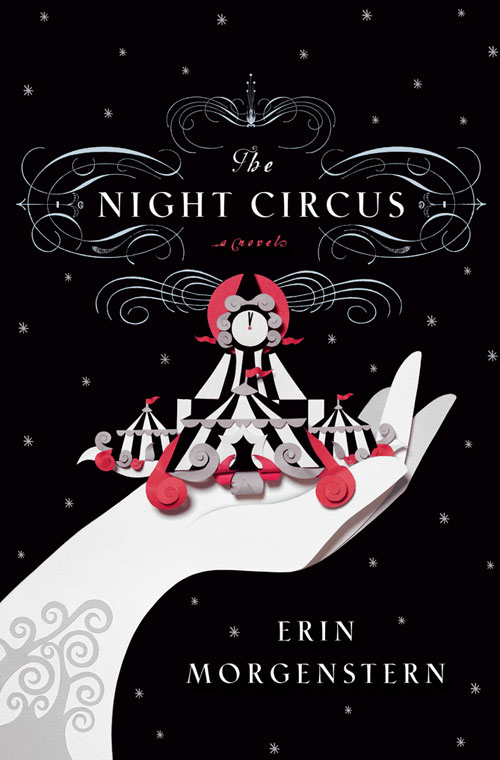
Sumer Reading: Post 4 - The Night Circus

Source
So I admit that including this one in my summer reading series is a little like cheating because this is a book Scott and I have been reading aloud together, but in my defense it is part of my summer reading.  I highly recommend Erin Morgenstern's The Night Circus, a fun, magical escape read.  My husband actually picked it out for us to read together (he rarely reads fiction) and described it to me as a book about two dueling magicians and a circus that appears mysteriously in different towns and cities across the world; one day it's there, the next it could possibly disappear without notice.  I was hooked and I hope you think it sounds magical too, because it is! It's been so much fun to read.

The plot and character development keeps your attention, you can't wait to see where it takes you next, and you're traveling everywhere from London, Paris, Munich, and Cairo.  The descriptions of the circus acts, costumes, and enchantments are brilliant and unique.  As one reviewer describes it, "It is intensely visual . . . Morgenstern paints precise, evocative and visually lush scenes within the tents of her fictional circus. Reading the novel is, in this respect, more like watching a film in the making – not an ordinary film, however, but an imaginative collaboration between writer and reader."  Though I wouldn't quite compare it to the genius world of Harry Potter, the world Morgenstern creates is similarly magical and dangerous (minus the monsters and creatures) but I'm sad to see that Twilight fans are lumped in as expected fan readers here.  Whatever you might hear, from what I can tell about Twilight, The Night Circus is vastly different!

There are several different covers of the book, but each one is really spectacular, and they give you a feel for what awaits inside.  I think it would certainly be fun to see it made into a movie; my bets are that it will be before we know it, and Scott and I have had a time trying to decide who would be best to play the various characters.  So if you're looking to get away this summer we highly recommend Erin Morgenstern's The Night Circus!

Source
Source

Tuesday, 26 June 2012

Summer Reading: Post 3 - 1984

"Books were just a commodity that had to be produced, like jam or bootlaces."

My (hopefully consistent) summer reading series about books I somehow missed reading till now continues.  This week I read 1984 by George Orwell (and yes, this was my first time reading it unfortunately).  I read Animal Farm in my sophomore English class in high school and I remember I really enjoyed it, particularly the brief discussions we had in class.   A friend of mine gave me my copy of 1984 for my seventeenth birthday at the beginning of my senior year.  It's traveled with me during my three moves since then, and though I hadn't yet read it, I always included it in my boxes of books, placing it on the shelves with all the others upon arrival in my new places.  For the past two and a half years it's spent its days next to Scott's paperback copy of Animal Farm.

Picture of the slogan in 1984: War is Peace. Slavery is Freedom. Ignorance is Strength.  Source
Similar to Beloved I started 1984 once before, but was unsuccessful, obviously.  But once again, picking it up now I was hooked from the beginning.  Because I'd already read Margaret Atwood's The Handmaid's Tale twice I couldn't help but envision her world while reading 1984.  I highly recommend both Atwood and Orwell if dystopian literature appeals to you at all.

Even though I envisioned similar 'worlds' while reading these two books, they are not at all similar in their portrayal of women and the working-class (Atwood focuses more on women while Orwell focuses more on the working-class - referred to as the 'proles/proletarains' - there's a lovely diagram of the hierarchy of social classes in Orwell's world here).

Treatment of Women
I'm sure I could write a whole post devoted solely to the differences between how Orwell and Atwood treat women differently (and maybe I will).  Atwood is certainly concerned with how women are currently treated in society, giving us an over-exaggerated version so we can see the similarities between their society and ours - women are often used and viewed only as bodies and child-bearers.  Orwell's, on the other hand, seems to allow women more agency - - you have this (so it seems) kick-ass woman who is rebellious, but also talks of women, saying she lives "always in the stink of women! How I hate women!" (130).  While reading, I was taken aback several times by some of the small comments Orwell makes about women throughout the novel, referring to them as stupid and easily-manipulated, but perhaps we would have gotten similar comments if Atwood's novel had been written from a man's point of view; I'm sure the men in her world were thinking similar thoughts of abuse towards women.  But it was often hard to understand Orwell's motives and message about women (unlike Atwood who sets up a complex feminist agenda - although I'm sure some could and would argue about this).

Working-Class Heroes 
Though I didn't particularly appreciate Orwell's treatment of women, I did find the working-class/ 'proles' commentary fascinating.  Thanks to my last few classes in grad school I am intrigued by working-class studies; in fact, I've just ordered a book called What We Hold in Common: An Introduction to Working-Class Studies, edited by Janet Zaney.  I'm dying for it to arrive so I can explore  this new discipline, and honestly I'm interested in what this community of writers has to say about the working-class.  I'm also curious to see if these are people from the academy discussing working-class issues, or people who come from a working-class background (hoping it's a mixture of both).  Anyway, back to 1984...the proles play a huge role in the story and become quite glorified as a people (for me at least) throughout the book.  Though they are obviously looked down on (or better yet, ignored) by the Inner Party and Party members, the narrator certainly gives us reason to believe they're something special in fixing 'the problems:'

"What mattered were individual relationships, and a completely helpless gesture, an embrace, a tear, a word spoken to a dying man, could have value in itself.  The proles, it suddenly occurred to him, had remained in this condition.  They were not loyal to a party or a country or an idea, they were loyal to one another.  For the first time in his life he did not despise the proles or think of them merely as an inert force which would one day spring to life and regenerate the world.  The proles had stayed human. They had not become hardened inside.  They had held onto the primitive emotions which he himself had to relearn by conscious effort . . . 'The proles are human beings,' he said aloud, 'We are not human'" (165).

And to me this is so powerful: "The proles were immortal; you could not doubt it when you looked at that valiant [woman] figure in the yard.  In the end their awakening would come.  And until that happened, though it might be a thousand years, they would stay alive against all odds, like birds, passing on from body to body the vitality which the Party did not share and could not kill . . . The birds sang, the proles sang, the Party did not sing . . . everywhere stood the same solid unconquerable [woman] figure, made monstrous by work and childbearing, toiling from birth to death and still singing.  Out of those mighty loins a race of conscious beings must one day come.  You were the dead; theirs was the future.  But you could share in the future if you kept alive the mind as they kept alive the body, and passed on the secret doctrine that two plus two make four" (221-2).


"And the people under the sky were also very much the same - everywhere, all over the world, hundreds or thousands of millions of people just like this, people ignorant of one another's existence, held apart by walls of hatred and lies, and yet almost exactly the same - people who had never learned to think but were storing up in their hearts and bellies and muscles the power that would one day overturn the world.  If there was hope, it lay in the proles!"

There were several times when reading about the working-class proles of 1984 I was reminded of two recent films - In Time and The Hunger Games - which both depict working-class characters trying desperately to change the socio-political hierarchies in their respective worlds.  But the working-class characters also display the 'human' qualities discussed in Orwell, examples of humanity in societies that have become inhumane in their actions and policies.

The Role of Sex
Finally, it's interesting that the role of sex is similar in both Orwell's and Atwood's novels.  Sex is repressed by the societies, and sex is only seen as appropriate for procreation (if you've read the book, you'll see why the cover illustration below is so funny - or maybe that was just me).  As Orwell writes,

"Sexual intercourse was to be looked on as a slightly disgusting minor operation, like having an enema" (65).


"What was more important was that sexual privation induced hysteria, which was desirable because it could be transformed into war fever and leader worship . . . When you make love you're using up energy; and afterwards you feel happy and don't give a damn for anything.  They can't bear you to feel like that.  They want you to be bursting with energy all the time.  All this marching up and down and cheering and waving flags is simply sex gone sour . . . There was a direct, intimate connection between chastity and political orthodoxy" (133).


Interesting cover art, not at all what I pictured while I was reading (source)
And per routine, here are some more quotes I found intriguing:

"He was a lonely ghost uttering a truth that nobody would ever hear.  But so long as he uttered it, in some obscure way the continuity was not broken.  It was not by making yourself heard but by staying sane that you carried on the human heritage" (28).

"It struck him as curious that you could create dead men but not living ones" (48).

I particularly found the discussions about Newspeak interesting: "It's a beautiful thing, the destruction of words.  Of course the great wastage is in the verbs and adjectives, but there are hundreds of nouns that can be got rid of as well.  It isn't only the synonyms; there are also antonyms.  After all, what justification is there for a word which is simply the opposite of some other words?  A word contains its opposite in itself . . . Every year fewer and fewer words, and the range of consciousness always a little smaller" (51-2).

"Always in your stomach and in your skin there was a sort of protest, a feeling that you had been cheated of something that you had a right to.  It was true that he had no memories of anything greatly different.  In any time that he could accurately remember, there had never been quite enough to eat, one had never had enough socks or underclothes that were not full of holes, furniture had always been battered and rickety, rooms underheated, Tube trains crowded, houses falling to pieces, bread dark-colored, tea a rarity, coffee filthy-tasting, cigarettes insufficient - nothing cheap and plentiful except synthetic gin . . . Why should one feel it to be intolerable unless one had some kind of ancestral memory that things had once been different?" (60).

"The obvious, the silly, and the true had got to be defended.  Truisms are true, hold on to that! The solid world exists, its laws do not change.  Stones are hard, water is wet, objects unsupported fall toward the earth's center" (81).

I guess one of the things that fascinated me most about reading 1984 was how relevant and timeless it is, not in every aspect of course, but certainly in many: "For if leisure and security were enjoyed by all alike, the great mass of human beings who are normally stupefied by poverty would become literate and would learn to think for themselves; and when once they have done this, they would sooner or later realize that the privileged minority [a.k.a. the 1%] had not function, and they would sweep it away.  In the long run, a hierarchical society was only possible on a basis of poverty and ignorance.  To return to the agricultural past, as some thinkers about the beginning of the twentieth century dreamed of doing, was not a practical solution.  It conflicted with the tendency toward mechanization which had become quasi-instinctive throughout almost the whole world, and moreover, any country which remained industrially backward was helpless in a military sense and was bound to be dominated, directly or indirectly, by its more advanced rivals" (190).

Sunday, 17 June 2012

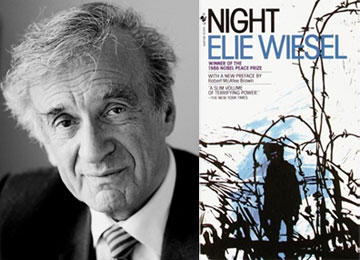
Summer Reading: Post 2 - Night

" . . . books, just like people, have a destiny.  Some invite sorrow, others joy, some both." 
- - Elie Wiesel

Source
Night by Elie Wiesel
I've read a lot of Holocaust Literature and other books, fiction and nonfiction, centered around the Jewish Holocaust (To See You Again, The Sunflower, Sarah's Key, The Book Thief, and Maus to name a few great ones) but I sadly hadn't read Night, which we all know is so short it can literally be read in an afternoon.  So what was I doing with my time and in my classes?  Well, for one reading Jane Austen's novels over and over again for numerous different courses.

Even though Night is deemed one of the 'classics of Holocaust Literature,' I found its abrupt ending somewhat unsettling and it just seemed like there was something missing.  In the Preface, Wiesel mentions that the book, which "was written in Yiddish as And the World Remained Silent and translated first in French, then into English - was rejected by every major publisher, French and American" (8).  He also notes that he made numerous cuts and was told countless times that it was just too long (although most of us know it's fairly short for a memoir/novel, my copy was just 135 pages).  Though the version I read was a more recent translation, I sensed that perhaps these cuts might have been extremely important and should have been left in as he would have liked.  In the Preface he gives several examples of narrative that was cut when translated into English and these seemed to me the strongest, most reflective of the book.  Most likely he included them in the Preface so that they could, in a sense, be included despite publishers' best efforts to keep them out.

Perhaps I've just read so many other narratives about the Holocaust that touched me more (others were written from young women's perspectives, which might have something to do with it?) or maybe I started reading, knowing that there were things missing that he would have liked to have included.  Either way it was an honest portrayal of his devastating experience during the Holocaust, but more importantly, as he writes in the Preface:

"In retrospect I must confess that I do not know, or no longer know, what I wanted to achieve with my words.  I only know that without this testimony, my life as a writer - or my life, period - would not have become what it is: that of a witness who believes he has a moral obligation to try to prevent the enemy from enjoying one last victory by allowing his crimes to be erased from human memory" (6).

Source
More quotes from the Preface . . .

"Painfully aware of my limitations, I watched helplessly as language became an obstacle.  It became clear that it would be necessary to invent a new language.  But how was one to rehabilitate and transform words betrayed and perverted by the enemy?  Hunger - thirst - transport - selection - fire - chimney: these words all have intrinsic meaning, but in those times, they meant something else" (7).

"And so I persevered.  And trusted the silence that envelops and transcends words.  Knowing all the while that any of the fields of ashes in Birkenau carries more weight than all the testimonies about Birkenau.  For, despite all my attempts to articulate the unspeakable, 'it' is still not right" (8).

"To forget would be not only dangerous but offensive; to forget the dead would be akin to killing them a second time" (13).

"Sometimes I am asked if I know 'the response to Auschwitz;' I answer that not only do I not know it, but that I don't even know if a tragedy of this magnitude has a response.  What I do know is that there is 'response' in responsibility.  When we speak of this era of evil and darkness, so close and yet so distant, 'reponsibility' is the key word.  The witness has forced himself to testify.  For the youth of today, for the children who will be born tomorrow.  He does not want his past to become their future" (13).

Summer Reading: Post 1 - Beloved

One of my plans for this summer is to catch up reading books I (somehow) missed despite receiving a B.A. and M.A. in English Literature.  Though I don't want to make a rigorous schedule (like a job) for myself now that I've got some free time, I do want to check off some books that I've been somewhat ashamed to say I haven't read.  I'll be adding to my list as the summer goes on and hopefully I'll stay motivated to keep it up.  Most of the books I already own; I've been collecting them from book sales and clearance bins, hoping to get around to it.  I graduated from my Masters' program going on two weeks now and I'm only working a part-time job this summer (along with applying to new ones) so I figure now's a better time than ever to catch up!

To keep myself (and this blog) going I thought I'd post a few reactions or maybe just some quotes I found interesting while reading these summer books (I am on break after all), and to kick it off I've pulled quotes from the first two on my list: Toni Morrison's Beloved and Elie Wiesel's Night (Post 2).

Beloved by Toni Morrison
Though I've heard numerous conference papers on Beloved and others of Morrison's books I had yet to read any before this past week.  I already owned it and even attempted reading it once in undergrad, obviously unsuccessfully.  But this time as soon as I started I couldn't put it down.
Toni Morrison - source
"To Sethe, the future was a matter of keeping the past at bay.  The 'better life' she believed she and Denver were living was simply not that other one . . . As for Denver, the job Sethe had of keeping her from the past that was still waiting for her was all that mattered" (42).


"For a used-to-be-slave woman to love anything that much was dangerous, especially if it was her children she had settled on to love" (45).


"'I don't care what she is.  Grown don't mean nothing to a mother.  A child is a child.  They get bigger, older, but grown? What's that supposed to mean? In my heart it don't mean a thing'" (45).


And perhaps my favorite parts were the descriptions of Baby Suggs, holy . . .
"In the silence that followed, Baby Suggs, holy, offered up to them her great big heart.  She did not tell them to clean up their lives or to go and sin no more.  She did not tell them they were the blessed of the earth, its inheriting meek or its glorybound pure.  She told them that the only grace they could have was the grace they could imagine.  That if they could not see it, they would not have it.


'Here,' she said, 'in this here place, we flesh; flesh that weeps, laughs; flesh that dances on bare feet in grass.  Love it.  Love it hard . . . Move than your life-holding womb and your life-giving private parts, hear me now, love your heart.  For this is the prize'" (88-9).


"[The voices] had become an occasional mutter - like the interior sounds a woman makes when she believes she is alone and unobserved at work: a sth when she misses the needle's eye; a soft moan when she sees another chip in her one good platter; the low, friendly argument with which she greets the hens.  Nothing fierce or startling.  Just that eternal, private conversation that takes place between women and their tasks" (172).


"Clever, but schoolteacher beat him anyway to show him that definitions belonged to the definers - not the defined" (190).


"Grandma Baby said people look down on her because . . . [s]laves not supposed to have pleasurable feelings on their own; their bodies not supposed to be like that, but they have to have as many children as they can to please whoever owned them.  Still, they were not supposed to have pleasure deep down. She said for me not listen to all that.  That I should always listen to my body and love it" (209).


". . . we got more yesterday than anybody.  We need some kind of tomorrow" (273).

Sunday, 6 May 2012

Black Feminist Thought and The Help

Not too long ago I wrote a post called "Wrestling with The Help," realizing and contemplating the ways the film and book have been critiqued by the black community.  I have since continued thinking and 'wrestling' with it, and talking with others about their opinions.  What follows is a response for my feminist theory class, one that I wrote after reading Patricia Hill Collins' "The Politics of Black Feminist Thought" and several other articles concerning Black Feminist Theory.  Since there was such a great discussion that followed my last post on The Help, I thought I'd share this response for further conversation. . .

While reading Patricia Hill Collins’ piece “The Politics of Black Feminist Thought,” I was reminded of the recent controversy over Katherine Stockett’s book The Help and the movie released last August. The book and film depict, through a particular perspective, racism of Jackson, Mississippi during the early 1960s. Skeeter, a young white woman has just returned home from college and begins writing the stories of “the help,” hoping to become a ‘serious’ writer. Aibileen and Minnie are two of the black domestics who share their stories of raising white children and experiencing the oppressive roles as hired domestics, working for small wages and little respect.

As a young white woman myself, I read the book and watched the film, touched at the depiction of the black women caring for the white children like they are their own; for me, Aibileen is the real protagonist. I thought, naively, that the film and book had both portrayed the story of these women in a historically accurate way. However, I started reading articles and blog posts arguing that The Help depicted unrealistic and nostalgic images of the real race issues in the 1960s south, and I began to see that the black community was not nearly as receptive as the white community.

It soon became eerily reminiscent of what Collins asserts as “[s]uppressing the knowledge produced by any oppressed group mak[ing] it easier for dominant groups to rule because the seeming absence of an independent consciousness in the oppressed can be taken to mean that subordinate groups willingly collaborate in their own victimization” (52). I began to worry that the book and film did not fully articulate the complex intersectionality; instead as Trina Grillo writes, “sometimes the governing paradigms which have structured all or our lives are so powerful that we can think we are doing progressive work, dismantling the structures of racism and other oppressions, when in fact we are reinforcing the paradigms” (30). In other words, I started wondering whether The Help was dismantling or reinforcing racism and the oppression of domestic workers.

I watched a segment about The Help on Melissa Harris-Perry’s show on MSNBC, called “The Help doesn’t ‘help’ domestic workers.” Harris-Perry and guests’ criticisms of the film connect to Collins’ discussion of the “suppression of black feminist thought,” which “has been structured along three interdependent dimensions” (53). These dimensions include women’s labor, political mistreatment, and “the controlling images of Black women” (53). The controversy over The Help touches on two of these three dimensions specifically – women’s labor and the stereotypical images of Black women.

Source
First, Collins writes, “the exploitation of Black women’s labor – the ‘iron pots and kettles’ symbolizing Black women’s longstanding ghettoization in service occupations – represents the economic dimension of oppression” (53). One of the arguments against the film and book is that it only depicts Black women as domestics, unable to do anything else other than clean, cook, and take care of white babies. While this might be a historically accurate depiction of the south in the 1960s, it is perhaps one reason why the black community was so angry with the book and film; it is a contemporary depiction of women in exploitative roles that are represented in a somewhat nostalgic way.

Another dimension the controversy touched on – as well as Melissa Harris-Perry’s segment – is the “nexus of negative stereotypical images applied to African-American women” (53). Collins writes, “From the mammies, Jezebels, and breeder women of slavery to the smiling Aunt Jemimas on pancake mix boxes, ubiquitous Black prostitutes and ever-present welfare mothers of contemporary popular culture [these] negative [...] images [...] have been fundamental to Black women’s oppression” (53). Harris-Perry specifically mentions the danger of the depiction of black women in The Help, similar to what Collins asserts, as a way “to keep African-American women in an assigned, subordinate place” (53).
Source
To articulate this connection of the women’s roles in The Help and the dangerous stereotypical images connected to slavery, Harris-Perry suggested that viewers not only read the book and watch the film to form their own opinions, but also read Clinging to Mammy: The Faithful Slave in 20th Century America, by University of Connecticut professor Micki McElya, who argues, “Assertions of black people's contentment with servitude alleviated white fears while reinforcing racial hierarchy” (Google Books). Collins also mentions this reinforcement of hierarchy in her article: “Black women’s exclusion from positions of power within mainstream institutions has led to the elevation of elite white male ideas and interests and the corresponding suppression of Black women’s ideas and interests...” (53).

What I’ve learned as a young white woman after reading The Help, criticisms of the book and film, and Collins’ piece is that we must be receptive of these issues and how they might differ based on our own identities and experiences. Because members of the black community feel that The Help is a contemporary example of “economic exploitation” for Black women and a continuation of “negative stereotypes,” we must openly try to understand these arguments and why they are important in shaping and affecting our current culture and society.

Still, I see where the film and book can point out – even in small ways – the very injustices the black community wishes to bring to light. For example, in the film Skeeter tells her editor, “These colored women raise white children and in twenty years those children become the boss. We love them and they love us, but they can’t even use the toilets in our houses...” (The Help). Even though the film does have its many flaws and historical inaccuracies, I find moments like this, pointing to Maria Stewart’s own “object[ion] to the injustice of this situation: ‘We have pursued in shadow, they have obtained the substance; we have performed the labor, they have received the profits; we have planted the vines, they have eaten the fruits of them’” (qtd. in Collins 51). The lines from the film also point to what Collins calls Black women’s roles as “outsiders-within,” which “allowed African-American women to see the white elites [...from] a special Black women’s perspective” (56). Though The Help has its many flaws, and as a white woman I cannot fully understand, I can see how it can become a useful place for conversation about important race, class, and gender issues.

Thursday, 5 April 2012

Brian Doyle's 'Leap'

For my first night of assigned readings for my Creative Nonfiction class this quarter I got one of the authors mixed up on the syllabus and read the wrong reading.  This wouldn't have been that bad if I hadn't chosen that 'wrong' reading for my first response journal.  Come to find out that author's not even included in the syllabus - - 'Why yes, I am in my second year of grad school, preparing to graduate in June, why do you ask?'

Anyway, I didn't turn it in that day and make a fool of myself (although I really don't think our professor would've minded...she probably would've read it and given me a grade, but I chose not to give her the first impression of me as someone who can't even read the name off a syllabus correctly).  I digress...

I wanted to share the reading because I thought it was quite powerful, and well I have this useless response journal.  You can read the (very) short essay here and then I've posted my response below.  The essay is called "Leap" by Brian Doyle (the 'correct' author was Doty and they're right next to each other in the anthology, so see I wasn't too far off...okay well maybe I have no excuse).  We're using the Touchstone Anthology of Contemporary Creative Nonfiction edited by Williford and Martone.

Leap - excerpts from an essay by Brian Doyle (Acrylic, gouache, graphite on Tyvek)
by Kathleen Borkowski
Source: Kathleen Borkowski website
Brian Doyle’s “Leap” touched me in a way I could have never thought possible from a page and a half piece of writing. As a member of the ‘9/11 generation’ it took me only moments to realize what event he was discussing in his piece. Within seconds I was taken back to my eighth grade Home Economics classroom and the visions on the television of smoke and fire coming from the Twin Towers; we all sat mesmerized, horrified, watching the cameras pan from one image to the next. Our teacher had never experienced our silence before, and she wouldn’t again. In that moment, I felt ‘American’ in a way I’d never felt before and have never felt since. Doyle’s brief, but stunning piece took me back to that moment. It also conjured up a more recent image of the photograph in Extremely Loud and Incredibly Close by Jonathan Safran Foer depicting a man jumping from the tower.

Perhaps Doyle's influence and power in conjuring up these powerful images is what makes it such a great piece of writing. It takes us back and connects us to those moments, what we thought, how we felt, what we tried to tell ourselves to find some sense of comfort. In a brief page and a half he captures the moment, the people who witnessed the powerful image of the couple holding hands, and the connection to verses in the Bible.

His weaving of Scripture was perhaps what touched me the most; he tries to give words and meaning to the positive image witnessed amid the turmoil and tragedy. Even in the way he incorporates those Scriptures – “wrote John the Apostle” or “says the Book of Wisdom” – he makes it seem less like he’s pulling them from a holy text, and more like he’s quoting wise friends who provide wisdom in a time of need.

His inclusion of people’s names – the people who had watched as they leapt from the towers – seemed odd to me at first. As I read their names silently, I wondered why he had chosen this kind of ‘reportage’ style, quoting them as one would in a newspaper. But after reading through the entire piece, I understand that what Doyle might be doing is providing real witnesses, people who could, in a sense, ‘give voice’ to the circumstance, and in turn, share those images with us, as readers.

Though this piece, and its subject matter, has the danger of sounding ‘sentimental’ or overly optimistic, his has enough realism and an underlying message that death and tragedy, though inescapable, cannot be explained or understood. Instead, he urges that in those moments when we could easily focus on the “screaming souls of the murderers,” why not remember the “extraordinary ordinary succinct naked stunning perfect simple ferocious love?” (166).

I think what makes this a wonderful example of creative nonfiction is that he tells the story of a true event, while weaving in his own speculations and reflections. He has also tried to make connections to other tragedies, guiding his readers to see that love “is everything that we are capable of against horror and loss and death” (166). Even in this terrible moment, when it would have been easy to give up on the power of love, Doyle provides an articulate example that whether these two people were “husband and wife, lovers, dear friends, colleagues, strangers thrown together at the window there at the lip of hell,” they fought against the world’s evil as best they could until their moment of inescapable death. His reflections, along with the inclusion of the witnesses and Scriptures, are what make this a powerful example of creative nonfiction.

Thursday, 15 March 2012

.Welcome to Holland.

One reason I love being a teacher is that I get to guide students in learning new things; but another is that my students help me learn new things too!  This quarter I was blessed with a really great class - the students worked well together, there was a great sense of community, and they encouraged each other in their individual projects.  Overall, it was a great learning experience for me after last quarter which was unpleasant to say the least.  But I can see how I did things differently at the beginning of the quarter and how this created a better, more communal learning environment (sometimes difficult to create, I've found, with freshmen undergrads).

One of my students wrote her 102 paper arguing that parents should not choose to put their disabled children up for adoption.  She was very close to this issue because she is a triplet sister to a brother with cerebral-palsy. When she first began this project I wasn't sure where it would take her.  I didn't know that there would be many people out there against her argument, but we both found out there were plenty of counter-arguments to address. I tend to be pretty open to any project student might propose.  I mean, I won't let them go down a dangerous path that might have them frustrated and weary by the end, but I don't set strict limits about what they should do.  I have found so far that when they work through whatever problems might arise with their topics it can help them problem-solve and learn.

This quarter I also gave them the option (and encouraged them) to conduct interviews with someone connected to their topic in some way.  This student chose her mother and through that interview discovered a poem that her mother read when she found out about her son.  This was a special experience for the student and her mother; she told me she started to cry when her mother described the poem.  She shared it with me and I'm sharing it with you today!

Here's a recording of the poem or you can read it below - -


Welcome to Holland by Emily Perl Kingsley (1987)
I am often asked to describe the experience of raising a child with a disability - to try to help people who have not shared that unique experience to understand it, to imagine how it would feel. It's like this......


When you're going to have a baby, it's like planning a fabulous vacation trip - to Italy. You buy a bunch of guide books and make your wonderful plans. The Coliseum. The Michelangelo David. The gondolas in Venice. You may learn some handy phrases in Italian. It's all very exciting.


After months of eager anticipation, the day finally arrives. You pack your bags and off you go. Several hours later, the plane lands. The stewardess comes in and says, "Welcome to Holland."


"Holland?!?" you say. "What do you mean Holland?? I signed up for Italy! I'm supposed to be in Italy. All my life I've dreamed of going to Italy."


But there's been a change in the flight plan. They've landed in Holland and there you must stay.


The important thing is that they haven't taken you to a horrible, disgusting, filthy place, full of pestilence, famine and disease. It's just a different place.


So you must go out and buy new guide books. And you must learn a whole new language. And you will meet a whole new group of people you would never have met.


It's just a different place. It's slower-paced than Italy, less flashy than Italy. But after you've been there for a while and you catch your breath, you look around.... and you begin to notice that Holland has windmills....and Holland has tulips. Holland even has Rembrandts.


But everyone you know is busy coming and going from Italy... and they're all bragging about what a wonderful time they had there. And for the rest of your life, you will say "Yes, that's where I was supposed to go. That's what I had planned."


And the pain of that will never, ever, ever, ever go away... because the loss of that dream is a very very significant loss.


But... if you spend your life mourning the fact that you didn't get to Italy, you may never be free to enjoy the very special, the very lovely things ... about Holland.

Sunday, 4 March 2012

.StoryCorps: Every Voice Matters.

This weekend I've been working like a madwoman on the Appalachian class I'm building for one of my courses (we're starting our final week of the quarter tomorrow so needless to say it's nearly finished...or should be).  During one of the units we're supposed to have the students interact with people in some way.  In my class they'll be interviewing people in their community about the impact modern technology and media has on their place and heritage.  But, before they conduct these interviews they'll need to learn some interviewing skills.

To do this, we'll be watching the following animated clips, discussing interviewees' roles as 'living' sources and the interview process as a type of 'research.'  These clips are from a wonderful resource called StoryCorps, a non-profit organization that records and collects interviews to share on their website.  The librarian at my school introduced it to our class as a resource to use while generating ideas for our course designs. I wanted to share it on my blog because I'd never heard of StoryCorps, but I've enjoyed exploring the site.  I think it's an amazing resource that could be used and adapted in just about any classroom; it could also be a great family heritage project for anyone wanting to collect and share family stories.  You can see more animations of the recorded interviews here.


The Icing on the Cake: A young woman interviews her mother about their immigration to the U.S. from Mexico (have a tissue handy).


Q and A: A boy with Asperger's syndrome interviews his mother about the mysteries of life.

Monday, 16 January 2012

.It's the new year already?.

 I can't quite believe how long it's been since I've written on here.  The last post tells me it was mid-September, reminding me just how fast the last few months have gone.  And I have a feeling the next few will be zipping by just as fast.

If I was on a semester schedule at school I could say this is my last semester, but since we're on quarters I'll still have one more to go after the one at present - which I'll be going in to week 3 of 10 this week (see, flying by already).  I'll be graduating in June with an M.A. in English Literature and a Certificate in Women's Studies, searching for an adjunct teaching position at a community college close by - I hope! I've decided I'm just going to take my time in finding a job instead of scrambling around panicking.  I've got a growing number of guitar lessons to see me through the summer if need be anyway.  And Scott, too, is coming up on a new and exciting stage in his Ph.D program.  He's finished with coursework and will begin studying and taking Comps this semester, on top of teaching two general option religion courses.  He'll then begin working on his dissertation with two years paid to complete it.

On January 2nd we celebrated not only two years of wonderful marriage, but two years of successful studies in programs we're both blessed to be a part of.  Graduating this June will be bittersweet for me because I'm both ready to leave and sad to be finished (although my proposal for my independent paper is due next week so about mid-March I might really be ready to get out of all this mess).  But my real reason for being sad is the people - the TAs and professors who have been supportive and helpful every step of the way.  I've met some great people through my program and I'll be sad not to be able to share all the joys and frustrations of being a grad student teaching freshman composition.  I hope and pray I'll end up in a supportive and encouraging environment as a new teacher next year, whether at a private high school or community college.

All that said, this last semester (er...next to last quarter) has started exceedingly well (much better than the growing pains I experienced last quarter).  My class of freshmen are engaged and quite talkative actually, in a good way! And the courses I'm taking, while I felt a bit out of my comfort zone at first, are going really well - "Feminist Theory: Writing the Body" and my first Comp/Rhet class "Teaching Argument: ENG 102."  I'm very excited to be creating another themed class as part of the Teaching 102 course, this time working a theme into the argumentation freshman comp class.  I've decided on Place & Heritage, specifically focusing on the Appalachian culture.  My students will explore the issues, stereotypes, and heritage connected to the place of Appalachia, reflecting on their own cultures and heritage through interviews and readings.  I'm excited to be working on this project, though it seems a bit overwhelming right now, because I have such a connection to Appalachia and I think it'll be great to explore it in the classroom.  My independent paper topic also deals with Appalachia: the cinematic narrative creating a national identity in Muriel Rukeyser's The Book of the Dead, an epic poem depicting the Gauley Bridge Mining Tragedy in West Virginia.

Well I can't end a post without reading suggestions so here's what's been on my bedside table lately (thanks mostly to my husband for giving them to me as Christmas presents):

Mudhouse Sabbath: An Invitation to Life of Spiritual Discipline by Lauren Winner - As a convert from Judaism to Christianity, Winner finds small ways we, as Christians, can connect to our Jewish heritage.

Orange is the New Black: My Year in Women's Prison by Piper Kerman - I'm not sure why but I'm always fascinated by narratives about life in prison, whether it be on TV or in books.  Kerman attended a women's college, came from a good background, but did time for helping transport drugs.

Take This Bread by Sara Miles - Miles grew up in an atheist household, despite her grandparents' involvement in mission work and social activism in the name of God.  Her memoir tells of her conversion to Christianity after a serendipitous communion experience.  Read an excerpt here.

I also just finished the first book of The Hunger Games trilogy by Suzanne Collins and I can't wait to watch the movie coming out in March!  Until next time...

Sunday, 31 October 2010

.little worries.

Some recent events have had me a little worried about becoming a parent - and no the recent events do NOT include finding out that we're pregnant.  Mostly, it's been my growing agitation with young people and their lack of disrespect and creativity (and yes, I realize how old and "crotchety" I sound).

It all started when we were discussing in our TA meeting this week how we're all going to be those "mean" parents that don't let our kids have cell phones (or texting abilities at least) until they're much older.  It blows my mind to see children younger than 10 years old, staring into a cell phone screen and not looking up to see others around them.  How are they going to develop their imagination and creativity if they don't allow themselves to get bored every now and then?  Creativity is born in moments of pure boredom.  When you're left to find some way of occupying yourself, you dream, imagine, explore.  When there's always some way of occupying yourself, however, creativity does not grow and thrive.  Now, I know a lot of people will argue that technology allows children to grow and explore in new ways, but sometimes I think the best time can be spent doing something "hands on" and technology-free.

Another growing problem is with children not talking out loud.  It's as if they've become so accustomed to texting and replying with non-verbal answers, that they no longer possess the ability to vocalize their thoughts, opinions, or appreciation for that matter.

I have to say that I've felt pretty lucky so far with the class I was given this quarter.  For the most part my students are conscientious, polite, and respectful to me, but I've had a growing problem trying to get them to discuss and converse with each other.  Scott has expressed similar complaints about his freshmen, and it's caused me to wonder whether they're just nervous or scared, or whether they are becoming less prone to verbalizing their ideas.  They're growing up in a world where vocalizing is not the first means of communication; but rather, a type of written word has become the dominating form (I say type because it's definitely not the written word in its traditional sense).

I guess as an English teacher I should find this a hopeful development, but as I have seen in emails that my students send me, there is a total disregard for complete sentences, complete words (which probably blows my mind the most), and no longer do they capitalize "i."  I know it comes from the practice of texting, but I just wish they would learn to "code-switch;" different settings call for different types of communication.

This all comes back to my worries of becoming a parent - I promise.  It was hard enough growing up and being able to partake in most of the things my friends had.  Back then, though, it was Tamagotchi pets and "Hello Kitty" notebooks.  I can't imagine trying to raise a child and not allowing them to take part in something that has become such a large part of our culture.  I have a feeling that telling them it's for their own good won't really convince them - it didn't convince me.  Maybe it's up to our generation - those who are and will soon be having children - to restore sanity and the importance of vocalized communication together.  I'm all for the written word, but when our children no longer possess the abilities to verbalize their thoughts and feel comfortable doing so, there's something very wrong...

SplendidMarbles

Sunday, 17 October 2010

.my influential authors.

Okay, so I'm sort of cheating in this post because one of my friends tagged me in a note on Facebook asking me to name 15 influential authors that will always stay with me.  But I thought I would share it here too, and hopefully hear some of your favorite authors! 


Jane Austen
Charlotte Bronte
Eavan Boland
Margaret Atwood
Julian of Norwich
Fanny Fern (Sara Willis Parton)
Amy Tan
Murial Rukeyser
Billy Collins
Virginia Woolf
Lewis Carroll
Sue Monk Kidd
Sylvia Plath
Kate Chopin
Gwendolyn Brooks

Friday, 9 July 2010

.book fun.

In the Biola University online magazine, different professors share their favorite books using the following categories, followed by a small blurb about the book.  I thought it would be fun to do this as well so I've included mine....please share yours : )


Favorite Classic: (tie) "Northanger Abbey" by Jane Austen and "Little Women" by Louisa May Alcott - When asked which Jane Austen book they most enjoy, most people (that I have talked to at least) will reply "Pride and Prejudice" or "Sense and Sensibility," but I prefer this less-popular work by dear Jane.  And who doesn't love spunky Jo March and her sisters?

Best Book for the Beach: "Shopoholic" series by Sophia Kinsella - These are my guilty pleasure books and please don't judge them by the recently-released movie.  Don't get me wrong, I love Isla Fisher and Hugh Dancy, but the books are 10 times more hilarious (and ridiculous) than the movie!

Book Everyone Tells Me I Should Read and Haven't: "Jane Eyre" by Charlotte Bronte - I'm pretty embarrassed to admit this being in an English Master's program and all, but I just haven't gotten around to it.  Believe me, I've got a copy, it's just a matter of sitting down and reading it.  I've heard the synopsis about a zillion times, though.  I have read the lesser-known of her novels, "Villette," and absolutely loved it! I think she might be my favorite of the Bronte sisters.

Best Book That Only Takes an Afternoon to Read: "The Trouble with Poetry" by Billy Collins - Okay, so I had to include my favorite poet and this book of poetry is a great introduction to his work.  He has a conversational, lay style while shedding new light on the small, day-to-day things.

Best Book From a Distant Land: (tie) "The Guernsey Literary and Potato Peel Pie Society" by Mary Ann Shaffer and "The Physick Book of Deliverance Dane" by Katherine Howe - It was hard for me to choose my favorite among all the historical fiction novels I've read, but I couldn't put down either one of these books.  "Guernsey Literary..." tells the story of a book club that is created in resistance to Nazi occupation on Guernsey Island. Books. Strong Women. 1940s WWII...can't get much better for me.  "Deliverance Dane," also fabulous. Set between the two worlds of the 1600s and 1990s Massachusetts, it tells the story of a graduate student working on her dissertation and learns about her own identity along the way.

Thursday, 8 April 2010

Discovering a New Epic

I had expected to read works like The Odyssey, Paradise Lost, and Beowolf in my Epic course this quarter.  What I did not expect was to learn about the more modern epics like Omeros, Loba, and The Waste Land.  Along with these "new" epics, I have stumbled onto Muriel Rukeyser's Book of the Dead.  It is an epic poem that illustrates the true story of the industrial disaster in West Virginia in 1927.  During the construction of the Hawk's Nest Tunnel in Gauley Bridge, West Virginia, workers were asked to mine silica, but were not given masks to use for protection.  "There are no definitive statistics, but several sources agree that resulting fatalities probably totalled approximately 700 of the 2000 workers." (Statemaster.com/encyclopedia)


The epic poem, Book of the Dead, is a heart-breakingly powerful work of poetry that details the catastrophic event through different voices and forms (even including the accounts of the trial and other mining data).  The epic begins with the beautiful images of West Virginia in THE ROAD and WEST VIRGINIA:


"These are roads to take when you think of your country.
Select the mountains, follow rivers back,
travel the passes.  Touch West Virginia...


The simple mountains, sheer, dark-graded pine
in the sudden weather, wet outbreak of spring,
crosscut the snow, wind at the hill's shoulder."


Reading on, the tone changes as we witness the personal accounts of the miners, their wives, doctors, and the committee assigned to the case.  This account is from a miner, Mearl Blankenship:


"He stood against the stove
facing the fire - 
Little warmth, no words,
loud machines.


Voted relief,
wished money mailed,
quietly under the crashing:


'I wake up choking, and my wife
'rolls me over on my left side;
'then I'm asleep in the dream I always see:
'the tunnel choked
'the dark wall coughing dust."
(from MEARL BLANKENSHIP)


Rukeyser captured the images of these West Virginians by traveling to Gauley Bridge to investigate the incident of the recurring deaths of the miners working on the tunnel.  The Book of the Dead is included in several of her collections, but was first published in 1938 in U.S. 1.  


An excerpt taken from her last poem in the collection:


"You standing over gorges, surveyors and planners,
you workers and hope of countries, first among powers;
you who give peace and bodily repose...


These are our strength, who strike against history.
These whose corrupt cells owe their new styles of weakness
              to our diseases;


these carrying light for safety on their foreheads
descended deeper for richer faults of ore,
               drilling their death.


These touching radium and the luminous poison,
carried their death in their lips and with their warning
               glow in their graves.


These weave and their eyes water and rust away,
these stand at wheels until their brains corrode,
              these farm and starve,


all these men cry their doom across the world,
meeting avoidable death, fight against madness,
                find every war...


Carry abroad the urgent need, the scene,
to photograph and to extend the voice,
             to speak this meaning.


Voices to speak to us directly. As we move.
As we enrich, growing in larger motion,
              this word, this power.


Down coasts of taken countries, mastery,
discovery at one hand, and at the other
               frontiers and forests,


fanatic cruel legend at our back and 
speeding ahead the red and open west,
               and this our region,


desire, field, beginning.  Name and road,
communication to these many men,
as epilogue, seeds of unending love."


*For the Raleigh County, West Virginia miners