Monday, 23 July 2012

Job Search: Over!

If you haven't noticed, I've been slacking on my Summer Reading posts lately.  I've been doing some fun-reading when I get the chance but the last couple of weeks have been devoted to drafting and revising resumes and cover letters and conducting job searches.  I think it's an understatement to say that it's not the best time to be looking for a job, and it certainly doesn't help when the political campaign and the news in general seems to remind us everyday.

Pretty funny, and sadly, still pretty true for the Class of 2012 (Source).
I've pretty much nearly driven myself crazy (just ask my husband, family, and best friends) applying for jobs, but I'm excited to report the search is over!  Last week I accepted a position at a STEM (Science, Technology, Engineering, and Math) middle/high school just down the street from where we live.  I'll be teaching three classes of 11th and 12th grade technical reading and writing, and serving as the school's yearbook advisor.  Not only is the school conveniently located a few blocks from our apartment, it seems like it's going to be a perfect fit for me - I love the faculty and staff I've met so far, the school stands for an ethics of creativity and craftsmanship, and I'll be getting paid to do what I love: teaching students how to read and write and guiding them to make a yearbook.  This job couldn't have been a better fit if I had planned it myself, but I know that wasn't the case.  I've been praying and praying for a job and this one pretty much landed in my lap.

Although I've enjoyed teaching Composition and Developmental Reading and Writing at the college level as a Teaching Assistant, I'm excited to get back in the high school environment, especially being a part of this unique school.  Over the past two years I drove by the STEM school as I went to classes everyday.  I watched excitedly as an old Value City department store transformed into an innovative, colorful school.  From the large glass windows in front I could see artwork, models, and sculptures in display cabinets and a colorful mural painted on the wall.  I saw students outside playing or conducting research, and as I watched the school grow and change I never could have imagined being a part of it, and now here I am.  I feel so blessed!

This weekend, I was so excited about getting back in the high school classroom with my own desk that I just had to browse the 'school supplies' aisles in Target (and refrain from buying everything!).  I was giddy looking at expandable file folders, white board markers in unique colors, and notebooks with owls on them.  I don't want the last weeks of summer to fly by, but I'm very excited for Back to School!

The next couple of weeks will be devoted to revising, creating, and planning a new curriculum for this Technical Reading and Writing course, guiding students toward an understanding in writing business letters, using other kinds of business communication, composing resumes and cover letters, creating user manuals and instructions, and writing with different types of technology.  I'm so excited to get started and more than anything, I'm excited that my job search is over.  I am a part of a school and a learning community and boy, does it feel great!

Sunday, 15 July 2012

A Love [Haiku] to My Body

If you regularly visit my blog you know that body is something I often write about, thanks to a course I took in grad school: 'Feminist Theory - Writing the Body.'  Yesterday Rachel Held Evans shared 'A Love Letter to my Body [in Haiku]', her contribution to the SheLoves synchroblog, A Love Letter to My Body.  For my contribution I've written a haiku about the mole above my upper left lip that I share with my maternal great-grandmother, grandmother, and mother.  I've written a poem about it before, but I composed this haiku just for this occasion.  I hope you'll join in the love!


My mole, shared with three
generations of women,
I hope to pass on.

Friday, 6 July 2012

Eating Dirt and Finding a Church

In my last post I wrote about reading Circling Faith, a book of essays by women about Southern Spirituality.  One essay that deserved more than simply sharing quotes was Beth Ann Fennelly's "Taking Terrior in Faith."

I learned a new concept from reading this essay, a practice called 'geophagy,' and it basically means the consumption of dirt clay.  Yes, from the ground . . . people eating dirt.  It brought a whole new meaning to the practice we joke about as a childhood pastime, making mud pies and cakes and joyfully feeling the mud between our fingers and toes.  

Fennelly writes, "The practice has been found on all continents, in various peoples, even in animals.  And in all times: Apparently, people have been eating the earth since they've been walking the earth . . . In the United States, geophagy has become associated with the South - usually with poor rural pregnant women, especially African American ones . . . slaves brought the habit with them to plantations, where it became known as Cachexia Africana" (53-4). It has now become an 'underground' activity, (you can purchase it on the internet and have it shipped to you in the mail) but is still commonly practiced by many people.  However, it's not like people are going out in their backyards and scooping mounds of earthworm-filled, gritty dirt into their mouths with a spoon.  Most of the actual clay comes from the South and it's taken from beneath ground level where it is uncontaminated with "manure, parasites, or pesticides" (56).
Source
She says there are five basic theories for why people eat dirt: (1) it satisfies hunger (2)  it provides minerals that might be lacking in people's diets (3) it can neutralize poisons (4) it has been known to reduce nausea and indigestion and (5) dirt is good for us.  

So what does geophagy have to do with faith?  Fennelly says that studying, researching, and considering why people consume dirt is similar to her "more serious quest to understand what [she] feel[s] about religion . . . now [she] see[s] that [her] interest in geophagy has mirrored the pattern of [her] interest in faith.  The questions they present are similar.  Both faith and geophagy are, for many, deepened by daily ritual.  They are frequently site-specific . . . we can find ourselves hungrier in some seasons than in others for their mysterious nourishment.  Both tastes are passed down, inherited from out parents.  Both seem absurd to non-practitioners" (59).  It seemed a pretty unlikely comparison to me, but it does seem to make sense, and I was certainly intrigued to learn about this unique practice that I'd never heard of before.  

She also discusses her search for a church, and it reminded me of my husband and my recent search for churches.  When we first moved to Dayton we went to so many churches I can't even remember all of them, carefully trying them on.  Which one fit?  Snug and comfortable, but leaving toe-room for growth?  

We finally found a small Episcopal church about 50 minutes away from us with friendly parishioners, a dedicated rector who delivered beautiful sermons, and a great mission to their community.  But we became frustrated in the commutes (especially in the wintertime) and in our inability (again, because of the commute) to become involved.  It seemed just right, except for its inconvenient location.  For the longest time we told ourselves that maybe a church this great meant we needed to work for it - God didn't think it should come to us that easy.  We were going to have to put in some effort.  But eventually a couple missed Sundays turned into weeks and months and we haven't been back since last summer.  And we've missed church.  

We attended several others close by for a couple months each, but nothing seemed to be working, not to mention the hospitality seemed nonexistent in some places (which seems to be another problem in churches altogether).  Then, we had what some call 'home-church', reading our Bible and Christian/Spiritual books together on our balcony or on the couch.  But I think we've both recently come to the conclusion that it's just not enough.  We want to be part of a church, even if we've had numerous bad experiences with them.  Similar to Fennelly, we feel a "vague, gnawing hunger, a hunger for food [we've] never eaten yet" (60).  Now, we hope to continue this search with a renewed appetite, and an invitation to a church our friends have recently started attending.  

Because of our own church-hunting experience, Fennelly's final words of her essay really resonated with me: ". . . we allow the body of another to become our own; the eating of the bread, the symbol of the body, brings about rebirth . . . I'm sticking with Sunday services though the dreamed-of clarity has not yet descended.  So many others have found nourishment here.  Maybe educating my palate is the first step.  Maybe the leap comes next" (61).

Thursday, 5 July 2012

Summer Reading: Post 6 - Circling Faith

"Faith is . . . not firm.  Nor is it a settled state or a fixed noun.  We've decided it is an ongoing process, a verb" (Reed and Horne 6).


"This is my living faith, an active faith, a faith of verbs: to question, explore, experiment, experience, walk, run, dance, play, eat, love, learn, dare, taste, touch, smell, listen, argue, speak, write, read, draw, provoke, emote, scream, sin, repent, cry, kneel, pray, bow, rise, stand, look, laugh, cajole, create, confront, confound, walk back, walk forward, circle, hide and seek"
- - Terry Tempest Williams


Circling Faith: Southern Women on Spirituality, Ed. by Wendy Reed and Jennifer Horne (Source)
I love the cover art for the book I've been reading this past week: simple, elegant, and it appropriately reminds me of the south - the bees, the bones, the flowers.  The lovely cover is what made me pick it up off the 'new in religion/spirituality' shelf at the library.  I thought it would be a great one to read after Winner's Still and although I didn't read all the essays in the collection, I did very much enjoy the ones I did read, skimming through many of the others.  The introduction to the book, written by the two editors, discusses the process of coming out with this second collection after receiving such great feedback from their first, All Out of Faith.  However, with their first book of essays they suspected a controversy but were met instead with lots of women who felt their own stories had been told - their voices were being heard and there were other women having questioning conversations about faith and spirituality.

So, they started work on this second collection: "The story begins: Two women and a laptop walk into a monastery. (There is no bar - the country's dry; there are no men - it's all nuns).  For inspiration, they'd brought books.  For sleep, they'd brought PJs.  For thirst, they'd stashed a cooler in the trunk.  This was before Eat, Pray, Love had sold millions of copies, inspiring women all over the world to seek spiritual retreat . . ." (3).  I was intrigued.  And what followed was a book of essays written by women discussing their relationship oftentimes with their body/flesh and their faith/spirituality.  "As several of our essayists note, we are, after all, creatures of flesh and spirit.  Remaining open to the wonder and mystery of both sometimes take courage.  With this book we are hoping to inspire conversation and encourage vulerability, to challenge memory, to up the volume.  What follows are voices, sartorial words echoing and tumbling, patching and mending . . ." (8). I became even more intrigued and excited as I began reading the essays.

What follows are quotes from the introduction and a couple of the essays that interested me and I found worth sharing.  Similar to the authors' comments in their introduction I was moved by the essayists' discoveries about their own connections with their bodies and spirits.

Reed and Horne (Source)
- - from "Introduction: A Faith of Verbs" by Reed and Horne
'Some keep the Sabbath going to church; / I keep it staying home" - - Emily Dickinson

"One mother expressed delight to read of faith being discussed outside the church walls.  For a while, she'd been telling people who asked, 'We home-church'" (5).

"We passed a pawn shop that proclaimed 'Jesus Saves' right alongside 'We Buy Guns.'  The oddest part, we decided, was that it didn't seem odd, and we agreed that it was a Southern thing, inexplicable to many, even - if we thought about it - to ourselves" (5).

"We remembered wondering, as a child, why you had to dress up to go to church and being told that it had to do with showing respect to God, which included wearing a slip with your dress . . . Was God some kind of fashion police?  Did God listen only to those who were properly attired?  Wasn't God more present in the exaltation you felt in the high limbs of a tree or in the feeling of running barefoot across a soft lawn, than in the itchy tights and hard patent-leather shoes you wore to church?" (7-8).


"It's all very well to consider the lilies in the field, but a lily never experience closet trauma or wondered whether the field made her butt look big" (8).


- - from "Amazons in Appalachia" by Marilou Awiakta:

"I am Cherokee.
      My people believe in the Spirit that unites all things.
      I am woman.  I am life force.  My word has great value.
      The man reveres me as he reveres Mother Earth and his own spirit . . .
      Women share in all of life.  We lead sacred dances.  In the Council we debate freely with men until an agreement is reached.  When the nation considers war, we have a say, for we bear the warriors.
      Sometimes I go into battle.  I also plant and harvest . . .
      I love and work and sing.
      I listen to the Spirit.
      In all things I speak my mind.
      I walk without fear.
      I am Cherokee" (63-4).

"The Grandmother's hand on my arm halts my imaginings.  We stand at the edge of a secluded clearing, rimmed with tall pines.  In the center is a large log house and around it women - many women - move through sun and shadow.  Some walk in the clearing . . . A great weaving is going on here, a deep bonding . . . 'This is the menstrual lodge,' says the Grandmother.  'When our power sign is with us, we come here.  It is a sacred time - a time for rest and meditation.  No one is allowed to disturb our harmony.  No warrior may even cross our path.  In the menstrual lodge many things are known, many plans are made'" (68-9).

- - from "What the Body Knows" by Barbara Brown Taylor:
"Sacraments schooled me in the wedding of spirit and flesh.  I learned how to do the official ones in church - not just communion, but also baptism, reconciliation, the laying on of hands - and then, when I had the hang of seeing the holy in the most ordinary things, I moved on to celebrating the sacraments of picnic lunches, ordinary baths, forgiving embraces, and rubbing sick friends' feet.  Once you get the pattern down, there is really no place to stop.  Every material thing opens a door to the infinite.  Every bodily activity holds sacred possibility.   All that is necessary for this transformation to take place is someone to see it and say so, taking one small piece of the world in her hands and saying a blessing over it" (107).

"Every single day I am presented with the opportunity to wake up, say something kind and thankful over this body, and offer it to the world in a way that promises to be useful.  I accept the sacraments of other people's bodies in the same way.  They feed me, I feed them: bread of heaven, cup of salvation, given for you . . . Knowing neither the end nor the beginning, my body knows this: this is my soul's home on earth, in which I am pleased to dwell" (110).

- - from "Alice Walker Calls God 'Mama:' An Interview with Alice Walker" by Valerie Reiss
"I think that if there are periods when you're not doing something that you're used to doing, it means that you can spend that time doing something else.  If I get up and I think I'm going to write something and it's not there, rather than sitting there and trying to wait for it or try to give it a little nudge, I think, 'Oh, I can do something else with this time.' And then, there's so much else to do" (189).

"I paint.  I garden.  I dance.  I cook. I farm.  I have never felt that the one thing that I am 'known for' is what I am" (189).

- - from "Signs of Faith" by Barbara Robinette Moss
"I put my hands on my torso and felt the metal staples under my shirt; my belly seemed hot, but I felt cold.  Cold and thin.  As if I'd been washed in hot water and had shrunk to practically nothing.  Or to my very essence.  No matter what - there was an awareness inside me, so unexplainable.  Isn't that God?  I argued.  God essence?  The drugs were catching up with me and I felt too confused to go on ruminating.  A floating feeling washed over me and my eyes closed.  Dear God, I prayed, help me find my way" (197).

Monday, 2 July 2012

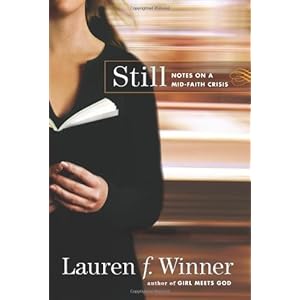
Summer Reading: Post 5 - Still

"...the whole bookstore is a self-help section to me.  When something needs to be fixed. When I need something to change, my first and abiding instinct is to read.  I think I can read my way to a solution.  Or at least an evasion." - - Lauren Winner, Still: Notes on a Mid-Faith Crisis


Lauren Winner's Still: Notes on a Mid-Faith Crisis (Source)
I picked up Lauren Winner's newest book Still: Notes on a Mid-Faith Crisis from the library last week, planning to read it between breaks with Iris Murdock's Nuns and Soldiers, which I'm reading with a couple of my girlfriends. Scott introduced me to Winner by giving me Mudhouse Sabbath for Christmas, which I love, so I thought I'd read this one next (she also has one called Girl Meets God which is more about her journey into Christianity).  Winner was raised Jewish but became a Christian in college, and she now teaches at the Duke Divinity School in Durham, North Carolina.  Her writing has an easy, conversational flow, and I oftentimes find myself taking notes (or highlighting) when I read her.  I seem to really relate to her self-deprecations, her honesty and humor in admitting that she's not perfect by any means, but that admitting it and working towards positive change is the first step.  And ironically, though I wasn't raised Jewish I seem to relate to her more than other contemporary Christian writers I've tried.  I also enjoyed this book in particular because its structure and format reminded me somewhat of blog posts since many of her chapters were short and seemed like brief (but profound) reflections on daily activities.

In her own words, Winner describes Still as "a book about entering the middle, about being in the middle of the spiritual life . . . Once upon a time, I thought I had arrived.  Now I have arrived at a middle.  If life is long, I am still at the beginning of the middle.  Once I would have said, 'Blessed assurance, Jesus is mine.'  From here, I say with the poet, 'O Lord of melons, of mercy, though I am not ready, nor worthy, I am climbing toward you.'  This books represents a few miles of the climb.  I share it in the hope that you might find it good company for your own climbing" (Preface).

In the 'author q and a' section at the back of the book she describes it further: "I wanted to emphasize the subtle but hugely significant shift from depressed, intense crisis to pacific openness, from no sense of God to a new sense of God.  From wrenched and wrecked to calm communion with a God I both know and don't know . . . the real crisis point . . . is the prelude to the book.  The spiritual unraveling, the alienation from God that I felt . . . that is the backstory. . . [it] opens at the tail end of darkness.  The book is not primarily a picture of the darkness.  It is a picture of the end of the darkness, of the stumbling out of the darkness into something new" (202).

While I'm thankfully not going through the death of my mother or a divorce after a five-year marriage like Winner describes in her book, her story has certainly comforted me in my recent climbing (or I might even call it, hiking) the small hill that is job-hunting/what's next?/letting go-letting God/trying to remember everything's going to work out in the end/continuing my journey toward patience.

Because most of my current 'hiking/climbing' deals with trying not to worry about what's next in my life job-wise, Winner's sections on anxiety particularly resonated with me.  I felt like everything she was saying was addressed to me and I wanted to scream, "Yes, that's exactly how I feel!!"  Sometimes I think there are a lot of us who deal with anxiety but we feel like we're the only ones.  And then we hear other people's battles and finally realize it's not some weird phenomena.  Even sweating the small things, Winner suggests about herself and others that this is  "a sort of practice worrying so that when the next . . . crisis rolled around [we're] in good shape . . . This is one of the many ways I am just like my mother.  As far back as I can remember, anxiety has been my close companion, having taken up residence in the small second-floor bedroom of the house that is my body . . . I don't imagine it will ever tire of the neighborhood and move out."  Similarly, I can admit my battle with anxiety; like Winner I've been told all my life not to worry, but it's what comes naturally, the thorn in my flesh.

Again, Winner's words are a comfort: "One way to give up anxiety is to meditate . . . The desert saints said that the beginning of renouncing a thought is simply noticing it . . . after noticing a thought replace it with prayer."  Although I've been told all my life not to worry, it has never truly sunk in; I know worrying does absolutely no good and it's not going to change a thing.  But I'd never really considered it as "the greatest evil which can happen to the soul, sin only excepted" (Francis de Sales, 17th Century priest and writer).  "The anxious heart, in its flailings, loses hold on whatever graces God has bestowed upon it, and is sapped of the strength to resist the temptations of the Evil One who is all the more ready to fish in troubled waters."

Winner suggests, "When you are conscious that you are growing anxious, commend yourself to God and resolve steadfastly not to take any steps whatever to obtain the result you desire, until your disturbed state of mind is altogether quited," praying this prayer . . .

"O God of Peace, who hast taught us that in returning and rest we shall be saved, in quietness and in confidence shall be our strength: By the might of the spirit lift us, we pray thee, to thy presence where we may be still and know that thou art God."

When I picked up this book I didn't think it would have such an effect on me, mainly because I don't feel that I'm going through a 'mid-faith crisis;' but I am climbing, and aren't we all most of the time?  Or at least resting from a very recent climb? I'm sure I'll have to remind myself of these words about anxiety (perhaps tomorrow), remembering the prayer when I begin doubting, and I know that I've not gone through some kind of drastic change after reading this book - I will still get anxious and worried.  But I have been comforted a bit in knowing there are others who struggle with these same feelings, and others who are climbing even taller, more dangerous mountains than my current little mole-hole.