Monday, 6 August 2012

Art Museum Visit

This weekend Scott and I visited the Cincinnati Museum of Art, something we've been wanting to do since we've lived here but haven't had the chance yet.  The Eden Park area surrounding the museum is absolutely beautiful, providing breathtaking views of the city.

Look! There's Kentucky!
 

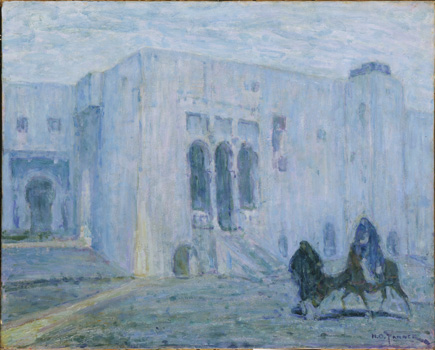
During our visit we discovered the work of Henry Ossawa Tanner, an Africa-American artist from Pittsburgh who lived from 1859 to 1937.  His art was featured as part of the special exhibit at the museum.  Many of his pieces are religious, and his work was by far our favorite.

This is the one he's probably most famous for.  I'd seen it in books but I didn't know he was the artist.  It's called Banjo Lesson - Source 

Flight into Egypt - Source
Teaching Jesus to Read - Source 
Daniel in the Lions' Den - Source
Angels Appearing Before the Shepherds - Source
Palace of Justice, Tangiers - Source

Christ at the Home of Mary and Martha - Source

Here are some of my other favorites from our visit.  You were allowed to take pictures of works older than the 1960s so these are my photographs of the pieces. 


Peasant Women of Borst (Elizabeth Nourse 1859-1938)

Eve Hearing the Voice (Moses J. Ezekiel 1844-1917)


Industry Protecting Art and Music, 1930 (Clement J. Barnhorn 1857-1935)

Jim Dine's Pinocchio lithographs were also really neat, part of the exhibit, In Celebration of Pinocchio.  You can see pictures of them here.  The exhibit is being held to celebrate the twelve-foot bronze sculpture that greets visitors outside the museum.


Saturday, 4 August 2012

Back to School!


Source
Thursday I got to set up my desk and classroom at the school where I'll begin teaching in a couple more weeks.  I actually get to meet my students this coming Tuesday at orientation, and I must say it feels quite surreal. For the past couple of weeks I've been putting stuff in a box to take with me to the school, making a few purchases at Target I just couldn't seem to pass up.  I also went to the local teaching supply store down the street from us.  I'd never allowed myself to go in before because I didn't have my own classroom yet, or a reason to need some of that stuff (bulletin board borders, cut-outs, 'good job!' stickers, plastic tubs in all shapes and sizes).  It was an awesome feeling walking the aisles with other teachers and overhearing their conversations about the coming school year.  I know several of my friends share an excitement for buying school supplies, but I'm sure it's an unusual recreational pastime for most.

And since taking the job my Pinterest activity has greatly increased; I've been filling my teaching board more and more everyday.  Mostly I've been excited to look at what other people have been doing in their classrooms - and wow! there are so many teaching blogs out there - I've found some really neat teaching ideas and classroom activities.

Source
Because I'm a total dork I took pictures of my desk and I wanted to share them. One of the other teachers helped me find a nice old wooden desk with lots of drawers and I'm so excited about it. And I love the green and tan checked floors in my room.  Now all that's left is meeting the students...can't wait!

On the side I hung positive messages from old calendar pages I had laminated when I was still in undergrad; it's amazing how much stuff I've been saving for when I become a teacher.  One is a quote by Helen Keller: "The best and most beautiful things in the world cannot be seen or even touched.  They must be felt with the heart."

...and my little desk caddy from Target.

Monday, 23 July 2012

Job Search: Over!

If you haven't noticed, I've been slacking on my Summer Reading posts lately.  I've been doing some fun-reading when I get the chance but the last couple of weeks have been devoted to drafting and revising resumes and cover letters and conducting job searches.  I think it's an understatement to say that it's not the best time to be looking for a job, and it certainly doesn't help when the political campaign and the news in general seems to remind us everyday.

Pretty funny, and sadly, still pretty true for the Class of 2012 (Source).
I've pretty much nearly driven myself crazy (just ask my husband, family, and best friends) applying for jobs, but I'm excited to report the search is over!  Last week I accepted a position at a STEM (Science, Technology, Engineering, and Math) middle/high school just down the street from where we live.  I'll be teaching three classes of 11th and 12th grade technical reading and writing, and serving as the school's yearbook advisor.  Not only is the school conveniently located a few blocks from our apartment, it seems like it's going to be a perfect fit for me - I love the faculty and staff I've met so far, the school stands for an ethics of creativity and craftsmanship, and I'll be getting paid to do what I love: teaching students how to read and write and guiding them to make a yearbook.  This job couldn't have been a better fit if I had planned it myself, but I know that wasn't the case.  I've been praying and praying for a job and this one pretty much landed in my lap.

Although I've enjoyed teaching Composition and Developmental Reading and Writing at the college level as a Teaching Assistant, I'm excited to get back in the high school environment, especially being a part of this unique school.  Over the past two years I drove by the STEM school as I went to classes everyday.  I watched excitedly as an old Value City department store transformed into an innovative, colorful school.  From the large glass windows in front I could see artwork, models, and sculptures in display cabinets and a colorful mural painted on the wall.  I saw students outside playing or conducting research, and as I watched the school grow and change I never could have imagined being a part of it, and now here I am.  I feel so blessed!

This weekend, I was so excited about getting back in the high school classroom with my own desk that I just had to browse the 'school supplies' aisles in Target (and refrain from buying everything!).  I was giddy looking at expandable file folders, white board markers in unique colors, and notebooks with owls on them.  I don't want the last weeks of summer to fly by, but I'm very excited for Back to School!

The next couple of weeks will be devoted to revising, creating, and planning a new curriculum for this Technical Reading and Writing course, guiding students toward an understanding in writing business letters, using other kinds of business communication, composing resumes and cover letters, creating user manuals and instructions, and writing with different types of technology.  I'm so excited to get started and more than anything, I'm excited that my job search is over.  I am a part of a school and a learning community and boy, does it feel great!

Sunday, 15 July 2012

A Love [Haiku] to My Body

If you regularly visit my blog you know that body is something I often write about, thanks to a course I took in grad school: 'Feminist Theory - Writing the Body.'  Yesterday Rachel Held Evans shared 'A Love Letter to my Body [in Haiku]', her contribution to the SheLoves synchroblog, A Love Letter to My Body.  For my contribution I've written a haiku about the mole above my upper left lip that I share with my maternal great-grandmother, grandmother, and mother.  I've written a poem about it before, but I composed this haiku just for this occasion.  I hope you'll join in the love!


My mole, shared with three
generations of women,
I hope to pass on.

Friday, 6 July 2012

Eating Dirt and Finding a Church

In my last post I wrote about reading Circling Faith, a book of essays by women about Southern Spirituality.  One essay that deserved more than simply sharing quotes was Beth Ann Fennelly's "Taking Terrior in Faith."

I learned a new concept from reading this essay, a practice called 'geophagy,' and it basically means the consumption of dirt clay.  Yes, from the ground . . . people eating dirt.  It brought a whole new meaning to the practice we joke about as a childhood pastime, making mud pies and cakes and joyfully feeling the mud between our fingers and toes.  

Fennelly writes, "The practice has been found on all continents, in various peoples, even in animals.  And in all times: Apparently, people have been eating the earth since they've been walking the earth . . . In the United States, geophagy has become associated with the South - usually with poor rural pregnant women, especially African American ones . . . slaves brought the habit with them to plantations, where it became known as Cachexia Africana" (53-4). It has now become an 'underground' activity, (you can purchase it on the internet and have it shipped to you in the mail) but is still commonly practiced by many people.  However, it's not like people are going out in their backyards and scooping mounds of earthworm-filled, gritty dirt into their mouths with a spoon.  Most of the actual clay comes from the South and it's taken from beneath ground level where it is uncontaminated with "manure, parasites, or pesticides" (56).
Source
She says there are five basic theories for why people eat dirt: (1) it satisfies hunger (2)  it provides minerals that might be lacking in people's diets (3) it can neutralize poisons (4) it has been known to reduce nausea and indigestion and (5) dirt is good for us.  

So what does geophagy have to do with faith?  Fennelly says that studying, researching, and considering why people consume dirt is similar to her "more serious quest to understand what [she] feel[s] about religion . . . now [she] see[s] that [her] interest in geophagy has mirrored the pattern of [her] interest in faith.  The questions they present are similar.  Both faith and geophagy are, for many, deepened by daily ritual.  They are frequently site-specific . . . we can find ourselves hungrier in some seasons than in others for their mysterious nourishment.  Both tastes are passed down, inherited from out parents.  Both seem absurd to non-practitioners" (59).  It seemed a pretty unlikely comparison to me, but it does seem to make sense, and I was certainly intrigued to learn about this unique practice that I'd never heard of before.  

She also discusses her search for a church, and it reminded me of my husband and my recent search for churches.  When we first moved to Dayton we went to so many churches I can't even remember all of them, carefully trying them on.  Which one fit?  Snug and comfortable, but leaving toe-room for growth?  

We finally found a small Episcopal church about 50 minutes away from us with friendly parishioners, a dedicated rector who delivered beautiful sermons, and a great mission to their community.  But we became frustrated in the commutes (especially in the wintertime) and in our inability (again, because of the commute) to become involved.  It seemed just right, except for its inconvenient location.  For the longest time we told ourselves that maybe a church this great meant we needed to work for it - God didn't think it should come to us that easy.  We were going to have to put in some effort.  But eventually a couple missed Sundays turned into weeks and months and we haven't been back since last summer.  And we've missed church.  

We attended several others close by for a couple months each, but nothing seemed to be working, not to mention the hospitality seemed nonexistent in some places (which seems to be another problem in churches altogether).  Then, we had what some call 'home-church', reading our Bible and Christian/Spiritual books together on our balcony or on the couch.  But I think we've both recently come to the conclusion that it's just not enough.  We want to be part of a church, even if we've had numerous bad experiences with them.  Similar to Fennelly, we feel a "vague, gnawing hunger, a hunger for food [we've] never eaten yet" (60).  Now, we hope to continue this search with a renewed appetite, and an invitation to a church our friends have recently started attending.  

Because of our own church-hunting experience, Fennelly's final words of her essay really resonated with me: ". . . we allow the body of another to become our own; the eating of the bread, the symbol of the body, brings about rebirth . . . I'm sticking with Sunday services though the dreamed-of clarity has not yet descended.  So many others have found nourishment here.  Maybe educating my palate is the first step.  Maybe the leap comes next" (61).

Thursday, 5 July 2012

Summer Reading: Post 6 - Circling Faith

"Faith is . . . not firm.  Nor is it a settled state or a fixed noun.  We've decided it is an ongoing process, a verb" (Reed and Horne 6).


"This is my living faith, an active faith, a faith of verbs: to question, explore, experiment, experience, walk, run, dance, play, eat, love, learn, dare, taste, touch, smell, listen, argue, speak, write, read, draw, provoke, emote, scream, sin, repent, cry, kneel, pray, bow, rise, stand, look, laugh, cajole, create, confront, confound, walk back, walk forward, circle, hide and seek"
- - Terry Tempest Williams


Circling Faith: Southern Women on Spirituality, Ed. by Wendy Reed and Jennifer Horne (Source)
I love the cover art for the book I've been reading this past week: simple, elegant, and it appropriately reminds me of the south - the bees, the bones, the flowers.  The lovely cover is what made me pick it up off the 'new in religion/spirituality' shelf at the library.  I thought it would be a great one to read after Winner's Still and although I didn't read all the essays in the collection, I did very much enjoy the ones I did read, skimming through many of the others.  The introduction to the book, written by the two editors, discusses the process of coming out with this second collection after receiving such great feedback from their first, All Out of Faith.  However, with their first book of essays they suspected a controversy but were met instead with lots of women who felt their own stories had been told - their voices were being heard and there were other women having questioning conversations about faith and spirituality.

So, they started work on this second collection: "The story begins: Two women and a laptop walk into a monastery. (There is no bar - the country's dry; there are no men - it's all nuns).  For inspiration, they'd brought books.  For sleep, they'd brought PJs.  For thirst, they'd stashed a cooler in the trunk.  This was before Eat, Pray, Love had sold millions of copies, inspiring women all over the world to seek spiritual retreat . . ." (3).  I was intrigued.  And what followed was a book of essays written by women discussing their relationship oftentimes with their body/flesh and their faith/spirituality.  "As several of our essayists note, we are, after all, creatures of flesh and spirit.  Remaining open to the wonder and mystery of both sometimes take courage.  With this book we are hoping to inspire conversation and encourage vulerability, to challenge memory, to up the volume.  What follows are voices, sartorial words echoing and tumbling, patching and mending . . ." (8). I became even more intrigued and excited as I began reading the essays.

What follows are quotes from the introduction and a couple of the essays that interested me and I found worth sharing.  Similar to the authors' comments in their introduction I was moved by the essayists' discoveries about their own connections with their bodies and spirits.

Reed and Horne (Source)
- - from "Introduction: A Faith of Verbs" by Reed and Horne
'Some keep the Sabbath going to church; / I keep it staying home" - - Emily Dickinson

"One mother expressed delight to read of faith being discussed outside the church walls.  For a while, she'd been telling people who asked, 'We home-church'" (5).

"We passed a pawn shop that proclaimed 'Jesus Saves' right alongside 'We Buy Guns.'  The oddest part, we decided, was that it didn't seem odd, and we agreed that it was a Southern thing, inexplicable to many, even - if we thought about it - to ourselves" (5).

"We remembered wondering, as a child, why you had to dress up to go to church and being told that it had to do with showing respect to God, which included wearing a slip with your dress . . . Was God some kind of fashion police?  Did God listen only to those who were properly attired?  Wasn't God more present in the exaltation you felt in the high limbs of a tree or in the feeling of running barefoot across a soft lawn, than in the itchy tights and hard patent-leather shoes you wore to church?" (7-8).


"It's all very well to consider the lilies in the field, but a lily never experience closet trauma or wondered whether the field made her butt look big" (8).


- - from "Amazons in Appalachia" by Marilou Awiakta:

"I am Cherokee.
      My people believe in the Spirit that unites all things.
      I am woman.  I am life force.  My word has great value.
      The man reveres me as he reveres Mother Earth and his own spirit . . .
      Women share in all of life.  We lead sacred dances.  In the Council we debate freely with men until an agreement is reached.  When the nation considers war, we have a say, for we bear the warriors.
      Sometimes I go into battle.  I also plant and harvest . . .
      I love and work and sing.
      I listen to the Spirit.
      In all things I speak my mind.
      I walk without fear.
      I am Cherokee" (63-4).

"The Grandmother's hand on my arm halts my imaginings.  We stand at the edge of a secluded clearing, rimmed with tall pines.  In the center is a large log house and around it women - many women - move through sun and shadow.  Some walk in the clearing . . . A great weaving is going on here, a deep bonding . . . 'This is the menstrual lodge,' says the Grandmother.  'When our power sign is with us, we come here.  It is a sacred time - a time for rest and meditation.  No one is allowed to disturb our harmony.  No warrior may even cross our path.  In the menstrual lodge many things are known, many plans are made'" (68-9).

- - from "What the Body Knows" by Barbara Brown Taylor:
"Sacraments schooled me in the wedding of spirit and flesh.  I learned how to do the official ones in church - not just communion, but also baptism, reconciliation, the laying on of hands - and then, when I had the hang of seeing the holy in the most ordinary things, I moved on to celebrating the sacraments of picnic lunches, ordinary baths, forgiving embraces, and rubbing sick friends' feet.  Once you get the pattern down, there is really no place to stop.  Every material thing opens a door to the infinite.  Every bodily activity holds sacred possibility.   All that is necessary for this transformation to take place is someone to see it and say so, taking one small piece of the world in her hands and saying a blessing over it" (107).

"Every single day I am presented with the opportunity to wake up, say something kind and thankful over this body, and offer it to the world in a way that promises to be useful.  I accept the sacraments of other people's bodies in the same way.  They feed me, I feed them: bread of heaven, cup of salvation, given for you . . . Knowing neither the end nor the beginning, my body knows this: this is my soul's home on earth, in which I am pleased to dwell" (110).

- - from "Alice Walker Calls God 'Mama:' An Interview with Alice Walker" by Valerie Reiss
"I think that if there are periods when you're not doing something that you're used to doing, it means that you can spend that time doing something else.  If I get up and I think I'm going to write something and it's not there, rather than sitting there and trying to wait for it or try to give it a little nudge, I think, 'Oh, I can do something else with this time.' And then, there's so much else to do" (189).

"I paint.  I garden.  I dance.  I cook. I farm.  I have never felt that the one thing that I am 'known for' is what I am" (189).

- - from "Signs of Faith" by Barbara Robinette Moss
"I put my hands on my torso and felt the metal staples under my shirt; my belly seemed hot, but I felt cold.  Cold and thin.  As if I'd been washed in hot water and had shrunk to practically nothing.  Or to my very essence.  No matter what - there was an awareness inside me, so unexplainable.  Isn't that God?  I argued.  God essence?  The drugs were catching up with me and I felt too confused to go on ruminating.  A floating feeling washed over me and my eyes closed.  Dear God, I prayed, help me find my way" (197).

Monday, 2 July 2012

Summer Reading: Post 5 - Still

"...the whole bookstore is a self-help section to me.  When something needs to be fixed. When I need something to change, my first and abiding instinct is to read.  I think I can read my way to a solution.  Or at least an evasion." - - Lauren Winner, Still: Notes on a Mid-Faith Crisis


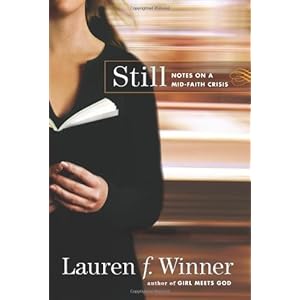
Lauren Winner's Still: Notes on a Mid-Faith Crisis (Source)
I picked up Lauren Winner's newest book Still: Notes on a Mid-Faith Crisis from the library last week, planning to read it between breaks with Iris Murdock's Nuns and Soldiers, which I'm reading with a couple of my girlfriends. Scott introduced me to Winner by giving me Mudhouse Sabbath for Christmas, which I love, so I thought I'd read this one next (she also has one called Girl Meets God which is more about her journey into Christianity).  Winner was raised Jewish but became a Christian in college, and she now teaches at the Duke Divinity School in Durham, North Carolina.  Her writing has an easy, conversational flow, and I oftentimes find myself taking notes (or highlighting) when I read her.  I seem to really relate to her self-deprecations, her honesty and humor in admitting that she's not perfect by any means, but that admitting it and working towards positive change is the first step.  And ironically, though I wasn't raised Jewish I seem to relate to her more than other contemporary Christian writers I've tried.  I also enjoyed this book in particular because its structure and format reminded me somewhat of blog posts since many of her chapters were short and seemed like brief (but profound) reflections on daily activities.

In her own words, Winner describes Still as "a book about entering the middle, about being in the middle of the spiritual life . . . Once upon a time, I thought I had arrived.  Now I have arrived at a middle.  If life is long, I am still at the beginning of the middle.  Once I would have said, 'Blessed assurance, Jesus is mine.'  From here, I say with the poet, 'O Lord of melons, of mercy, though I am not ready, nor worthy, I am climbing toward you.'  This books represents a few miles of the climb.  I share it in the hope that you might find it good company for your own climbing" (Preface).

In the 'author q and a' section at the back of the book she describes it further: "I wanted to emphasize the subtle but hugely significant shift from depressed, intense crisis to pacific openness, from no sense of God to a new sense of God.  From wrenched and wrecked to calm communion with a God I both know and don't know . . . the real crisis point . . . is the prelude to the book.  The spiritual unraveling, the alienation from God that I felt . . . that is the backstory. . . [it] opens at the tail end of darkness.  The book is not primarily a picture of the darkness.  It is a picture of the end of the darkness, of the stumbling out of the darkness into something new" (202).

While I'm thankfully not going through the death of my mother or a divorce after a five-year marriage like Winner describes in her book, her story has certainly comforted me in my recent climbing (or I might even call it, hiking) the small hill that is job-hunting/what's next?/letting go-letting God/trying to remember everything's going to work out in the end/continuing my journey toward patience.

Because most of my current 'hiking/climbing' deals with trying not to worry about what's next in my life job-wise, Winner's sections on anxiety particularly resonated with me.  I felt like everything she was saying was addressed to me and I wanted to scream, "Yes, that's exactly how I feel!!"  Sometimes I think there are a lot of us who deal with anxiety but we feel like we're the only ones.  And then we hear other people's battles and finally realize it's not some weird phenomena.  Even sweating the small things, Winner suggests about herself and others that this is  "a sort of practice worrying so that when the next . . . crisis rolled around [we're] in good shape . . . This is one of the many ways I am just like my mother.  As far back as I can remember, anxiety has been my close companion, having taken up residence in the small second-floor bedroom of the house that is my body . . . I don't imagine it will ever tire of the neighborhood and move out."  Similarly, I can admit my battle with anxiety; like Winner I've been told all my life not to worry, but it's what comes naturally, the thorn in my flesh.

Again, Winner's words are a comfort: "One way to give up anxiety is to meditate . . . The desert saints said that the beginning of renouncing a thought is simply noticing it . . . after noticing a thought replace it with prayer."  Although I've been told all my life not to worry, it has never truly sunk in; I know worrying does absolutely no good and it's not going to change a thing.  But I'd never really considered it as "the greatest evil which can happen to the soul, sin only excepted" (Francis de Sales, 17th Century priest and writer).  "The anxious heart, in its flailings, loses hold on whatever graces God has bestowed upon it, and is sapped of the strength to resist the temptations of the Evil One who is all the more ready to fish in troubled waters."

Winner suggests, "When you are conscious that you are growing anxious, commend yourself to God and resolve steadfastly not to take any steps whatever to obtain the result you desire, until your disturbed state of mind is altogether quited," praying this prayer . . .

"O God of Peace, who hast taught us that in returning and rest we shall be saved, in quietness and in confidence shall be our strength: By the might of the spirit lift us, we pray thee, to thy presence where we may be still and know that thou art God."

When I picked up this book I didn't think it would have such an effect on me, mainly because I don't feel that I'm going through a 'mid-faith crisis;' but I am climbing, and aren't we all most of the time?  Or at least resting from a very recent climb? I'm sure I'll have to remind myself of these words about anxiety (perhaps tomorrow), remembering the prayer when I begin doubting, and I know that I've not gone through some kind of drastic change after reading this book - I will still get anxious and worried.  But I have been comforted a bit in knowing there are others who struggle with these same feelings, and others who are climbing even taller, more dangerous mountains than my current little mole-hole.  

Thursday, 28 June 2012

Sumer Reading: Post 4 - The Night Circus

Source
So I admit that including this one in my summer reading series is a little like cheating because this is a book Scott and I have been reading aloud together, but in my defense it is part of my summer reading.  I highly recommend Erin Morgenstern's The Night Circus, a fun, magical escape read.  My husband actually picked it out for us to read together (he rarely reads fiction) and described it to me as a book about two dueling magicians and a circus that appears mysteriously in different towns and cities across the world; one day it's there, the next it could possibly disappear without notice.  I was hooked and I hope you think it sounds magical too, because it is! It's been so much fun to read.

The plot and character development keeps your attention, you can't wait to see where it takes you next, and you're traveling everywhere from London, Paris, Munich, and Cairo.  The descriptions of the circus acts, costumes, and enchantments are brilliant and unique.  As one reviewer describes it, "It is intensely visual . . . Morgenstern paints precise, evocative and visually lush scenes within the tents of her fictional circus. Reading the novel is, in this respect, more like watching a film in the making – not an ordinary film, however, but an imaginative collaboration between writer and reader."  Though I wouldn't quite compare it to the genius world of Harry Potter, the world Morgenstern creates is similarly magical and dangerous (minus the monsters and creatures) but I'm sad to see that Twilight fans are lumped in as expected fan readers here.  Whatever you might hear, from what I can tell about Twilight, The Night Circus is vastly different!

There are several different covers of the book, but each one is really spectacular, and they give you a feel for what awaits inside.  I think it would certainly be fun to see it made into a movie; my bets are that it will be before we know it, and Scott and I have had a time trying to decide who would be best to play the various characters.  So if you're looking to get away this summer we highly recommend Erin Morgenstern's The Night Circus!

Source
Source

Tuesday, 26 June 2012

Summer Reading: Post 3 - 1984

"Books were just a commodity that had to be produced, like jam or bootlaces."

My (hopefully consistent) summer reading series about books I somehow missed reading till now continues.  This week I read 1984 by George Orwell (and yes, this was my first time reading it unfortunately).  I read Animal Farm in my sophomore English class in high school and I remember I really enjoyed it, particularly the brief discussions we had in class.   A friend of mine gave me my copy of 1984 for my seventeenth birthday at the beginning of my senior year.  It's traveled with me during my three moves since then, and though I hadn't yet read it, I always included it in my boxes of books, placing it on the shelves with all the others upon arrival in my new places.  For the past two and a half years it's spent its days next to Scott's paperback copy of Animal Farm.

Picture of the slogan in 1984: War is Peace. Slavery is Freedom. Ignorance is Strength.  Source
Similar to Beloved I started 1984 once before, but was unsuccessful, obviously.  But once again, picking it up now I was hooked from the beginning.  Because I'd already read Margaret Atwood's The Handmaid's Tale twice I couldn't help but envision her world while reading 1984.  I highly recommend both Atwood and Orwell if dystopian literature appeals to you at all.

Even though I envisioned similar 'worlds' while reading these two books, they are not at all similar in their portrayal of women and the working-class (Atwood focuses more on women while Orwell focuses more on the working-class - referred to as the 'proles/proletarains' - there's a lovely diagram of the hierarchy of social classes in Orwell's world here).

Treatment of Women
I'm sure I could write a whole post devoted solely to the differences between how Orwell and Atwood treat women differently (and maybe I will).  Atwood is certainly concerned with how women are currently treated in society, giving us an over-exaggerated version so we can see the similarities between their society and ours - women are often used and viewed only as bodies and child-bearers.  Orwell's, on the other hand, seems to allow women more agency - - you have this (so it seems) kick-ass woman who is rebellious, but also talks of women, saying she lives "always in the stink of women! How I hate women!" (130).  While reading, I was taken aback several times by some of the small comments Orwell makes about women throughout the novel, referring to them as stupid and easily-manipulated, but perhaps we would have gotten similar comments if Atwood's novel had been written from a man's point of view; I'm sure the men in her world were thinking similar thoughts of abuse towards women.  But it was often hard to understand Orwell's motives and message about women (unlike Atwood who sets up a complex feminist agenda - although I'm sure some could and would argue about this).

Working-Class Heroes 
Though I didn't particularly appreciate Orwell's treatment of women, I did find the working-class/ 'proles' commentary fascinating.  Thanks to my last few classes in grad school I am intrigued by working-class studies; in fact, I've just ordered a book called What We Hold in Common: An Introduction to Working-Class Studies, edited by Janet Zaney.  I'm dying for it to arrive so I can explore  this new discipline, and honestly I'm interested in what this community of writers has to say about the working-class.  I'm also curious to see if these are people from the academy discussing working-class issues, or people who come from a working-class background (hoping it's a mixture of both).  Anyway, back to 1984...the proles play a huge role in the story and become quite glorified as a people (for me at least) throughout the book.  Though they are obviously looked down on (or better yet, ignored) by the Inner Party and Party members, the narrator certainly gives us reason to believe they're something special in fixing 'the problems:'

"What mattered were individual relationships, and a completely helpless gesture, an embrace, a tear, a word spoken to a dying man, could have value in itself.  The proles, it suddenly occurred to him, had remained in this condition.  They were not loyal to a party or a country or an idea, they were loyal to one another.  For the first time in his life he did not despise the proles or think of them merely as an inert force which would one day spring to life and regenerate the world.  The proles had stayed human. They had not become hardened inside.  They had held onto the primitive emotions which he himself had to relearn by conscious effort . . . 'The proles are human beings,' he said aloud, 'We are not human'" (165).

And to me this is so powerful: "The proles were immortal; you could not doubt it when you looked at that valiant [woman] figure in the yard.  In the end their awakening would come.  And until that happened, though it might be a thousand years, they would stay alive against all odds, like birds, passing on from body to body the vitality which the Party did not share and could not kill . . . The birds sang, the proles sang, the Party did not sing . . . everywhere stood the same solid unconquerable [woman] figure, made monstrous by work and childbearing, toiling from birth to death and still singing.  Out of those mighty loins a race of conscious beings must one day come.  You were the dead; theirs was the future.  But you could share in the future if you kept alive the mind as they kept alive the body, and passed on the secret doctrine that two plus two make four" (221-2).


"And the people under the sky were also very much the same - everywhere, all over the world, hundreds or thousands of millions of people just like this, people ignorant of one another's existence, held apart by walls of hatred and lies, and yet almost exactly the same - people who had never learned to think but were storing up in their hearts and bellies and muscles the power that would one day overturn the world.  If there was hope, it lay in the proles!"

There were several times when reading about the working-class proles of 1984 I was reminded of two recent films - In Time and The Hunger Games - which both depict working-class characters trying desperately to change the socio-political hierarchies in their respective worlds.  But the working-class characters also display the 'human' qualities discussed in Orwell, examples of humanity in societies that have become inhumane in their actions and policies.

The Role of Sex
Finally, it's interesting that the role of sex is similar in both Orwell's and Atwood's novels.  Sex is repressed by the societies, and sex is only seen as appropriate for procreation (if you've read the book, you'll see why the cover illustration below is so funny - or maybe that was just me).  As Orwell writes,

"Sexual intercourse was to be looked on as a slightly disgusting minor operation, like having an enema" (65).


"What was more important was that sexual privation induced hysteria, which was desirable because it could be transformed into war fever and leader worship . . . When you make love you're using up energy; and afterwards you feel happy and don't give a damn for anything.  They can't bear you to feel like that.  They want you to be bursting with energy all the time.  All this marching up and down and cheering and waving flags is simply sex gone sour . . . There was a direct, intimate connection between chastity and political orthodoxy" (133).


Interesting cover art, not at all what I pictured while I was reading (source)
And per routine, here are some more quotes I found intriguing:

"He was a lonely ghost uttering a truth that nobody would ever hear.  But so long as he uttered it, in some obscure way the continuity was not broken.  It was not by making yourself heard but by staying sane that you carried on the human heritage" (28).

"It struck him as curious that you could create dead men but not living ones" (48).

I particularly found the discussions about Newspeak interesting: "It's a beautiful thing, the destruction of words.  Of course the great wastage is in the verbs and adjectives, but there are hundreds of nouns that can be got rid of as well.  It isn't only the synonyms; there are also antonyms.  After all, what justification is there for a word which is simply the opposite of some other words?  A word contains its opposite in itself . . . Every year fewer and fewer words, and the range of consciousness always a little smaller" (51-2).

"Always in your stomach and in your skin there was a sort of protest, a feeling that you had been cheated of something that you had a right to.  It was true that he had no memories of anything greatly different.  In any time that he could accurately remember, there had never been quite enough to eat, one had never had enough socks or underclothes that were not full of holes, furniture had always been battered and rickety, rooms underheated, Tube trains crowded, houses falling to pieces, bread dark-colored, tea a rarity, coffee filthy-tasting, cigarettes insufficient - nothing cheap and plentiful except synthetic gin . . . Why should one feel it to be intolerable unless one had some kind of ancestral memory that things had once been different?" (60).

"The obvious, the silly, and the true had got to be defended.  Truisms are true, hold on to that! The solid world exists, its laws do not change.  Stones are hard, water is wet, objects unsupported fall toward the earth's center" (81).

I guess one of the things that fascinated me most about reading 1984 was how relevant and timeless it is, not in every aspect of course, but certainly in many: "For if leisure and security were enjoyed by all alike, the great mass of human beings who are normally stupefied by poverty would become literate and would learn to think for themselves; and when once they have done this, they would sooner or later realize that the privileged minority [a.k.a. the 1%] had not function, and they would sweep it away.  In the long run, a hierarchical society was only possible on a basis of poverty and ignorance.  To return to the agricultural past, as some thinkers about the beginning of the twentieth century dreamed of doing, was not a practical solution.  It conflicted with the tendency toward mechanization which had become quasi-instinctive throughout almost the whole world, and moreover, any country which remained industrially backward was helpless in a military sense and was bound to be dominated, directly or indirectly, by its more advanced rivals" (190).

Sunday, 17 June 2012

Summer Reading: Post 2 - Night

" . . . books, just like people, have a destiny.  Some invite sorrow, others joy, some both." 
- - Elie Wiesel

Source
Night by Elie Wiesel
I've read a lot of Holocaust Literature and other books, fiction and nonfiction, centered around the Jewish Holocaust (To See You Again, The SunflowerSarah's KeyThe Book Thief, and Maus to name a few great ones) but I sadly hadn't read Night, which we all know is so short it can literally be read in an afternoon.  So what was I doing with my time and in my classes?  Well, for one reading Jane Austen's novels over and over again for numerous different courses.

Even though Night is deemed one of the 'classics of Holocaust Literature,' I found its abrupt ending somewhat unsettling and it just seemed like there was something missing.  In the Preface, Wiesel mentions that the book, which "was written in Yiddish as And the World Remained Silent and translated first in French, then into English - was rejected by every major publisher, French and American" (8).  He also notes that he made numerous cuts and was told countless times that it was just too long (although most of us know it's fairly short for a memoir/novel, my copy was just 135 pages).  Though the version I read was a more recent translation, I sensed that perhaps these cuts might have been extremely important and should have been left in as he would have liked.  In the Preface he gives several examples of narrative that was cut when translated into English and these seemed to me the strongest, most reflective of the book.  Most likely he included them in the Preface so that they could, in a sense, be included despite publishers' best efforts to keep them out.

Perhaps I've just read so many other narratives about the Holocaust that touched me more (others were written from young women's perspectives, which might have something to do with it?) or maybe I started reading, knowing that there were things missing that he would have liked to have included.  Either way it was an honest portrayal of his devastating experience during the Holocaust, but more importantly, as he writes in the Preface:

"In retrospect I must confess that I do not know, or no longer know, what I wanted to achieve with my words.  I only know that without this testimony, my life as a writer - or my life, period - would not have become what it is: that of a witness who believes he has a moral obligation to try to prevent the enemy from enjoying one last victory by allowing his crimes to be erased from human memory" (6).

Source
More quotes from the Preface . . .

"Painfully aware of my limitations, I watched helplessly as language became an obstacle.  It became clear that it would be necessary to invent a new language.  But how was one to rehabilitate and transform words betrayed and perverted by the enemy?  Hunger - thirst - transport - selection - fire - chimney: these words all have intrinsic meaning, but in those times, they meant something else" (7).

"And so I persevered.  And trusted the silence that envelops and transcends words.  Knowing all the while that any of the fields of ashes in Birkenau carries more weight than all the testimonies about Birkenau.  For, despite all my attempts to articulate the unspeakable, 'it' is still not right" (8).

"To forget would be not only dangerous but offensive; to forget the dead would be akin to killing them a second time" (13).

"Sometimes I am asked if I know 'the response to Auschwitz;' I answer that not only do I not know it, but that I don't even know if a tragedy of this magnitude has a response.  What I do know is that there is 'response' in responsibility.  When we speak of this era of evil and darkness, so close and yet so distant, 'reponsibility' is the key word.  The witness has forced himself to testify.  For the youth of today, for the children who will be born tomorrow.  He does not want his past to become their future" (13).

Summer Reading: Post 1 - Beloved

One of my plans for this summer is to catch up reading books I (somehow) missed despite receiving a B.A. and M.A. in English Literature.  Though I don't want to make a rigorous schedule (like a job) for myself now that I've got some free time, I do want to check off some books that I've been somewhat ashamed to say I haven't read.  I'll be adding to my list as the summer goes on and hopefully I'll stay motivated to keep it up.  Most of the books I already own; I've been collecting them from book sales and clearance bins, hoping to get around to it.  I graduated from my Masters' program going on two weeks now and I'm only working a part-time job this summer (along with applying to new ones) so I figure now's a better time than ever to catch up!

To keep myself (and this blog) going I thought I'd post a few reactions or maybe just some quotes I found interesting while reading these summer books (I am on break after all), and to kick it off I've pulled quotes from the first two on my list: Toni Morrison's Beloved and Elie Wiesel's Night (Post 2).

Beloved by Toni Morrison
Though I've heard numerous conference papers on Beloved and others of Morrison's books I had yet to read any before this past week.  I already owned it and even attempted reading it once in undergrad, obviously unsuccessfully.  But this time as soon as I started I couldn't put it down.
Toni Morrison - source
"To Sethe, the future was a matter of keeping the past at bay.  The 'better life' she believed she and Denver were living was simply not that other one . . . As for Denver, the job Sethe had of keeping her from the past that was still waiting for her was all that mattered" (42).


"For a used-to-be-slave woman to love anything that much was dangerous, especially if it was her children she had settled on to love" (45).


"'I don't care what she is.  Grown don't mean nothing to a mother.  A child is a child.  They get bigger, older, but grown? What's that supposed to mean? In my heart it don't mean a thing'" (45).


And perhaps my favorite parts were the descriptions of Baby Suggs, holy . . .
"In the silence that followed, Baby Suggs, holy, offered up to them her great big heart.  She did not tell them to clean up their lives or to go and sin no more.  She did not tell them they were the blessed of the earth, its inheriting meek or its glorybound pure.  She told them that the only grace they could have was the grace they could imagine.  That if they could not see it, they would not have it.


'Here,' she said, 'in this here place, we flesh; flesh that weeps, laughs; flesh that dances on bare feet in grass.  Love it.  Love it hard . . . Move than your life-holding womb and your life-giving private parts, hear me now, love your heart.  For this is the prize'" (88-9).


"[The voices] had become an occasional mutter - like the interior sounds a woman makes when she believes she is alone and unobserved at work: a sth when she misses the needle's eye; a soft moan when she sees another chip in her one good platter; the low, friendly argument with which she greets the hens.  Nothing fierce or startling.  Just that eternal, private conversation that takes place between women and their tasks" (172).


"Clever, but schoolteacher beat him anyway to show him that definitions belonged to the definers - not the defined" (190).


"Grandma Baby said people look down on her because . . . [s]laves not supposed to have pleasurable feelings on their own; their bodies not supposed to be like that, but they have to have as many children as they can to please whoever owned them.  Still, they were not supposed to have pleasure deep down. She said for me not listen to all that.  That I should always listen to my body and love it" (209).


". . . we got more yesterday than anybody.  We need some kind of tomorrow" (273).

Wednesday, 13 June 2012

Antiquing and Gender Politics

Another short creative nonfiction piece I wrote for class - might as well share them now that it's over, right?

Ten Maple is an eclectic antique store I stumbled into one day when I was early for work, delightfully so. It’s located right off a bustling road, but when I parked in their gravel lot I felt like I’d stepped away from the busy world a little bit, hearing the birds chirping in the low-hanging trees and smelling the honeysuckle growing nearby. I made my way up to the front porch of the house, noticing the antiques sitting outside like they’d been there the entirety of their lives – a galvanized watering can, an assortment of terra cotta roosters, a concrete statue of a rabbit. The house has white siding with blue accents, and there’s a deep brick porch in the front, providing lots of shade for the chalkboard signs hanging out front: ‘fall down seven times, stand up eight’ and ‘learn to live, learn to love’ written in whimsically neat characters.

The screen door let out a slight groan when I opened it and I was greeted by more antiques – a menagerie of owls I nearly squealed over, miniature tea sets, and vases of all colors and shapes. The old hardwood floors creaked as I moved around the front room, and a woman appeared from the back. She had on jean capris and an easy blouse, holding a paintbrush in her hand. Her hair was pulled back in a loose ponytail and wisps were fleeing comfortably from her face. I want to look like that when I’m her age, I thought immediately, smiling and saying hello most certainly in my mountain accent. I felt instantly comfortable in her presence. Within minutes we were talking about her son who did his master’s and worked on his PhD up until his dissertation, and had a difficult time getting a job. I told her I’d be graduating in the spring, hopefully employed soon, and my husband would begin his dissertation in the fall. We moved onto the economy and politics, the crazy weather and the unfairness of the public school system. I left with a terra cotta rooster for my mother’s birthday and, as my husband would say later, ‘a new best friend.’

I took Scott there a week or so later so we could choose a few things for his mother and grandmother for Mothers’ Day.  We moved together through the rooms of the house, touching plates and pictures, picking up miniatures of cardinals and bluebirds. He picked up a white ceramic frog with his wide mouth open, ready to dutifully hold a dish sponge and stand guard the sink.

“Hey, we need one of these,” he said, sincerely. Anyone else would’ve thought this was a joke or sarcasm, a guy trying to make fun of this clearly feminine pastime – ‘antiquing.’ But he was serious. He handed it to me and I carried it around close to my chest.


The owner found us in the back trying to decide between a sunflower votive-holder and a hanging hook that looked like a bird in it’s nest for his mother. We decided on both because they were so affordable.

 “This is my husband,” I said, introducing him to my ‘new best friend.’

“Oh!” she said, “Now that’s something you don’t see everyday. A man out antiquing and enjoying it.”

As she said it, Scott was still comparing the sunflower and bird hook, clearly enjoying this part of the process – deciding between these two items.

“I’ve got a feminine side,” he said in reply.
. . .

I think about what this means, that we’ve all put ourselves in these boxes from the beginning. How it must mean Scott has a special connection to his feminine side because he doesn’t find antiquing similar to watching paint dry. How I get all defensive when we meet a new couple and the wife inevitably asks whether I like to cook. I try to make some excuse like, “I don’t really have time” or “My schedule doesn’t really allow it,” (which are both only partly true) when I’d really like to say, “Hell no, I don’t like to cook.  My husband does though!”

I’m reminded of the time when we left Steak and Shake for an early lunch, heading out to my car. Two old men were talking beside their trucks and they looked at us quizzically, “Why aren’t you making him drive?” they asked.

“Because it’s my car and I can drive just fine,” I replied, probably a little too defensively.

“Well, he should be chauffeuring you around,” they said, chuckling.

I wish I’d said, “It’s none of your business really. I’m out working while he’s home cooking dinner most nights...what do you think of that?” But I didn’t say anything. I just nervously laughed and closed the car door, infuriated.
. . .

“Did you see these owls?” he says, holding one up for me to see.

“Uh...YEAH! I want all of them,” I say, handing over the money to pay for our purchases. He carries the gifts and opens the door for us to walk out to our car. He puts the stuff in the back and gets in on the passenger side.

Thursday, 7 June 2012

'Bad Girls:' Weaving the Fabric of Women

I just started reading Eve's Bible: A Woman's Guide to the Old Testament by Sarah S. Forth - thanks to my husband who saw it while browsing in the library - and though I don't agree with some of her assertions, I'm certainly intrigued by her emphasis on women "weaving ourselves into the fabric of biblical history" (41).  I am reminded of many of the readings from my Feminism and Christianity class that served to do this very thing, uncovering the (often) 'invisible' women of the Bible.  Many of us who heard Bible stories as children and attended Bible School rarely heard about the fascinating women of biblical times, or we were introduced to them as Bad Girls of the Bible (a book I actually studied in youth during high school).  Instead, the great men of the Bible served as examples for Christian discipleship, even though there are countless women who stand as powerful examples for Christian women (I've - sadly - only recently become acquainted with them while reading through Women of the Bible by Ann Spangler and Jean E. Syswerda, and many other empowering articles from the F/C class).

Forth continues Judith Plaskow's call to Christian women, "to reevision the biblical tradition [and] claim our place in the collective memory" (34).  In her chapter, "Putting Women Back into Sacred History," she writes,

While camped in the shadow of Mount Sinai, Moses called together the 'people of Israel' and instructed them to prepare for what would be the signal event of their forty years in the desert: receiving the laws of Yhwh (Yaweh).  After telling them to wash their clothes and to not approach the mountain from which God would speak, Moses added, 'Prepare for the third day; do not go near women' (Ex. 19:15).  


'At the very moment when Israel stands trembling waiting for God's presence to descend upon the mountain, Moses addresses the community only as men,' writes the Jewish scholar Judith Plaskow.  'Women are invisible.'


Plaskow calls upon women . . . 'to stand again at Sinai.'  By this she means to assert that women were there - at Sinai and all other junctures of sacred history (34).

Forth describes three ways that women can 'stand at Sinai' and remember that women were part of the fabric of Biblical history: (1) "excavate historical women," find their stories and tell them (this was something our professor of Feminism/Christianity urged of us as well, to share women's stories with our friends, children, family, anyone who would listen), (2) "reinterpret the historical record," take back the stories that have been used against as part of patriarchy in the Church, only viewing women as 'bad girls' and (3) imagine the experiences of these biblical women, 'using our creativity and imagination . . . to shape a new history for ourselves" as women, using "music, our bodies, paint, cloth, clay, or any other means at our disposal" (43).

"In our history-making, [Elizabeth] Schussler Fiorenza urges us to reject the violence and alienation [that have come about because of patriarchal interpretations of the Bible] (43). Here is one example of what Fiorenza calls a 'narrative amplification' of an existing story: 'Miriam's Song' by Julia Stein, taken from her book Shulamith, a collection of poems about biblical and modern Jewish women.  Stein supplies a missing viewpoint by assuming the voice of Miriam to describe the ten plagues that preceded the Israelites' release from bondage in Egypt" (41).

I've included only excerpts of the poem, but I thought it was absolutely beautiful!

Miriam's Song


I swept the house through nine plagues,
swept when Moses turned the river into blood,


swatted at frogs all day in Egyptians' kitchen,
chased frogs in the bedrooms, whacked at them


on the beds, jumped after frogs in the kitchen.  Next
I cleaned off the lice from the heads of the Egyptians . . . 


Before the tenth plague I swept once more, 
then roasted lamb and cut up bitter herbs we ate


remembering four hundred years of slavery
that terrible night the Angel of Death screeched


and screamed as he flew over our houses
on his bloody way to kill the Egyptians' sons . . . 


I wanted to smash the pyramids.
We'd built them well.  They'd last. A pity.


At the Red Sea, after we climbed onto the land and 
saw Pharaoh lead his chariots into a gap


riding between two huge cliffs of water when
mountains of water crashed down on them,


I called the women who came with cymbals and drums,
'Come dance now for we are flying into freedom.' 

Miriam's Song: Sing a Joyful Noise Unto the World, by Laura James, Ethiopian Iconographer, Giclee print
Source: eyekons.com via Jade on Pinterest

Tuesday, 5 June 2012

Christ as Feminist Leader

It's 'One in Christ: Mutuality Week' on Rachel Held Evans' blog and she's challenging other bloggers to discuss similar issues.  A friend and fellow blogger contributed beautifully on her blog, and many others have taken the challenge.  I'm also enjoying Julie Clawson's series on Discovering Christian Feminism.  Though I'm still stumbling around with my own Christian feminism, trying to find the words for my convictions, I thought I'd share excerpts from a paper I wrote while taking a Christianity and Feminism course this past winter.  This course only served to get my feet wet in the teachings and interpretations of Christian feminism, but I hope this will contribute in some (small) way to this fabulous discussion going on in the blogosphere.


Christianity and Feminism: Christ as Feminist Leader, the Church as Socio-Political Movement 

Following Christ’ requires concrete, specific action, not merely adherence to the tenets of a given religious organization.  Rosemary Radford Ruether declares that we must see Christ as a “liberator, not in the spiritual sense but in real terms in the political and social realm” (“Introductions” 33). His own ministry could be interpreted as a socio-political movement that Christians must continue in our own time. Leondard Swidler asserts that Jesus is a feminist, “a person who is in favor of, and promotes, the equality of women with men, who advocates and practices treating women primarily as human persons (as men are so treated) and willingly contravenes social customs in so acting” (17). I would like to take Swidler’s definition even further to assert that Jesus was a feminist, not only in his advocacy of women, but in his advocacy of the equality of all peoples. In this way, I argue that Christ embodies “Womanism” in his teachings and actions on earth.

Womanist theology, as defined by Linda Moody, emphasizes the “interconnectedness of the human race,” and “does not allow the categories of sexism, classism, and racism to become separated” (qtd. in Johnson 198). Christ came to earth as a model to God’s children of “full humanity,” and more specifically what it means to be a follower of God (Swidler 42). For much of his life on earth he spent his time not with the lawmakers and rulers, but with the oppressed, sick, and poor, praising the “lowly and outcast for responding to his message while the reigning authorities stay encapsulated in their systems of power” (Isherwood 34). Much of his time with the poor and oppressed he lifted them up, healed them, and assured them that all are seen as equals in the eyes of God. When Jesus teaches the Beatitudes his first blessing is to the “poor, for yours is the kingdom of God [...those who] hunger now [...] will be satisfied” (Luke 6:20-21). He preaches, “If you want to be perfect, go, sell your possessions and give to the poor, and you will have treasure in heaven. Then come, follow me” (Matt 19:21). These examples from Scripture make a call for Christians to become humbled and follow Christ, a calling for all peoples to be viewed and treated equally in the eyes of God.

Image of God
Unfortunately, certain Christian interpretations have equated the ‘image of God’ with men; Christ came bearing the outward physical appearance of a man, so many have argued that men are the superior sex. Mary Daly explains, “the underlying assumption in the minds of theologians down through the centuries has been that the divinity could not have deigned to become incarnate in the ‘inferior’ sex, and the ‘fact’ that ‘he’ did not do so reinforces the belief in a masculine superiority” (59). However, I argue that perhaps man needed a more explicit example of what a follower of God should be, perhaps needing more guidance in the area of humility, grace, and mercy, traits that have been traditionally associated with women and the feminine. 

The Faithfulness of Women in Jesus' Time
When we look at the teachings of Christ, many times he praises women for their faithfulness, and reprimands men for their selfish actions. This is exemplified when Jesus visits a doubtful Pharisee in his home. When a woman who had lived a sinful life in that town learns that Jesus was eating at the Pharisee’s house, she brought an alabaster jar of perfume, and as she stood behind him at his feet weeping, she began to wet his feet with her tears. Then she wiped them with her hair, kissed them and poured perfume on them. (Luke 7:36-38). This sinful woman shows unbelievable faith in Christ, humbling herself at his feet, while Simon questions him and says, “If this man were a prophet, he would know who is touching him and what kind of woman she is – that she is a sinner” (7:39). Jesus tells him that this woman’s faith is what saves her, and that she is forgiven all her sins, “go in peace” (7:50).

In stark contrast to the faith shown by this woman, the disciples doubt Christ when they are at sea, waking him to tell of the raging storm. Calmly, Jesus asks them, “Where is your faith?” (8:25). Another example of a woman’s strong faith is when the sick woman touches Christ in the crowd and is healed. She shares Christ’s instant miracle, to which He replies, “Daughter, your faith has healed you. Go in peace” (8:48). In each of these examples, women are faithful followers of Christ, while men constantly question Him. Perhaps Christ’s male appearance is for the sake of these unfaithful, unbelieving men; he is a more obvious model for them to follow since women already have much faith. 

Another critique of the patriarchal emphasis on Jesus’ ‘male-ness’ focuses on Christ’s androgyny. According to this argument, despite his physical appearance, Christ took on both “so-called” feminine and masculine qualities, providing Christians with an androgynous model for living as “authentic humans, [rejecting] the false division of traits by sex” (Swidler 42). Christ depicted both “feminine” and “masculine” traits so that “we [as followers] will come to know, and love, our true, integrated self and will thereby be able to see our oneness with all our fellow humans (and most especially the oppressed), with all nature, and ultimately with the Source of all” (Swidler 42). Not only did he challenge the sexual norms, he rejected the societal norms of his time by teaching the “Good News” to all people – women (Luke 38-42), men (Matt 14:22-33), tax collectors (Luke 19:1-10), adulterers (John 8), prostitutes (Luke 8:1-3), criminals (Luke 23:32-43), and Gentiles (Matt 15: 21-25). Each group of people fills different roles in the social hierarchy created by man, and in each of these Biblical examples Christ does not adhere to cultural or societal rules. Instead, “[He] was committed to social and political action, the undoing of social evil and aspirations that are expressed in the Lord’s Prayer, where the kingdom is imaged on earth and signaled by the meeting of basis needs for all” (Isherwood 36). He challenged the social norms of his day, specifically, in the way that he treated women.

Breaking Down the Hierarchical Barriers
During his time, men were not permitted to speak to women, or touch them, because their sex was seen as “easily seduced, weak, and without much understanding” (qtd. in Swidler 21). But Christ explicitly defies these rules in his attitude toward and interaction with women. Christ spoke to women and “taught them the Gospel, the meaning of the Scriptures, and religious truths in general;” he appeared to women after healing the sick and rising from the dead, allowing them to bear witness and evangelize in his name (Swidler 23). He defied violations of the law in speaking directly to the Samaritan woman at the well, and touching the “unclean” woman, allowing them both to share with others the “Good News” that he was the Messiah (Swidler 26-7).

There are no instances when he treats women, the poor, or the oppressed as less than equal in God’s eyes. Instead, his most aggressive judgments are given to the merchants in the Tabernacle where he overturns the tables (Matt 21:12-14) and the Scribes and Pharisees who held themselves above others, rather than humbling themselves before God (Matt 23:13-33). Christianity, as a social movement, should see Christ’s actions as examples for the treatment of women, the oppressed, and the poor. As Christ reprimands the hypocritical Pharisees who view themselves as superior, he is explicitly teaching against man-made social hierarchy that was religiously sanctioned. 

In his rejection of social hierarchy for the sake of welcoming a coming kingdom, Jesus’ teachings are directly compatible with the ideas of Womanism and feminism. As Isherwood points out, “The kingdom is not here even though there are moments when the transcendent becomes present in an anticipatory way through justice, liberation, and reconciliation” (36). Christ hopes he and his followers – all Christians – will transform the world, allowing glimpses of the kingdom to come through justice and liberation – not only in our practices and actions, but equally so in our understanding of the biblical texts. If Jesus serves as exemplary figure for the equal treatment of all, preaching the inclusivity of the kingdom of God, then perhaps we can consider a more egalitarian view of the Genesis story, specifically the interpretation of Eve in the Christian tradition.

Genesis - Someone to Blame: Eve and all women
Historically, Eve is depicted as the sole cause of humanity’s Fall. However, I argue, along with many feminist theologians, that the figure Eve represents, in certain ways, a positive image of woman. Phyllis Trible, suggests that “we reread [Genesis 2-3] to understand and to appropriate” the circumstances and particulars surrounding the Fall (74). Trible asserts that there was no distinction between the sexes until the split of the androgynous first human. The word “‘adham is a generic term for humankind,” and so ‘adham is basically androgynous: one creature incorporating two sexes” (74). Still, some argue that once the split was made between the sexes, the woman was the second creature created, making women subordinate. However, Trible points out that when considering order, “the last shall be first and the first shall be last” (Matt 20:16). If making this argument, woman is a more complex creature, “the last and truly the crown of all creatures,” created after animals and man (75). Though oftentimes misinterpreted Eve can be seen as the stronger of the two, because she “is both theologian and translator. She contemplates the tree, taking into account all the possibilities [...] By contrast, the man is a silent, passive, and bland recipient [...] His one act is belly oriented, and it is an act of quiescence, not of initiative” (79).

Eve’s strength need not be see as a superiority over Adam; I maintain that both man and woman rejected God and are therefore culpable. However, it does mean that Eve’s actions are much more complex than have been traditionally understood. Rather than embodying the wicked temptress who willfully listened to the serpent and therefore caused the downfall of all humanity, Eve displays an emotional complexity that should be valued. Similarly, it should be understood that man and woman were equally present and aware of their consequences in taking the fruit, for God spoke to both in the Garden of Eden saying, “You are free to eat from any tree in the garden; but you must not eat of the Tree of the Knowledge of Good and Evil, for when you eat of it you will surely die” (Genesis 2:16-7). Readers must not continue to misinterpret and find false evidence for the inferiority of women; rather, an understanding must emerge wherein Genesis reinforces the equality of men and women.

Genesis’ teaching of gender equality can be taken a step further to enforce the equality of all peoples with no room for hierarchy or inferiority. AndrĂ© LaCocque takes Trible’s defense of Genesis further than gender equality, and asserts that all humans are part of a “common universal spirit” and “one familial cell.” The socio-political movement of Christianity, therefore, should not work under any kind of hierarchy or “subsequent divisions” since these are perversions of God’s Creation. James H. Cone asserts that certain Christian movements - particularly Black Theology - is already living out the socio-political activism of Jesus. Black Theology was born from the civil rights movement, and became a movement within the Christian faith to right the wrongs of racial discrimination.

While Black Theology primarily focuses on equality of race, it provides a valuable example of a social and politically active Christian community that works for the equality of all. Similarly, the Christian faith movement should right the wrongs of all injustices, striving to “not only pray for justice but also become actively involved in establishing it” (46). Christians cannot actively establish justice within the stuffy, confined walls of church sanctuaries that close their doors to people who might not believe the same way; instead these ideas must be taken out into the world, becoming an “expression of hope and a tool of struggle for liberation” of all people who are treated unjustly (Cone 37).

Call to Action
The socio-political Christian movement must fight the “injustices” of viewing certain people as inferior and treating them as less than others as defined by the perverse social hierarchy of our culture. Christians need to create a dialogue among Christian family and friends on how best to create this socio-political movement seeking to eradicate injustices against people, critically asking whether the current organized religious system is even conducive to justice for all people, since the church, itself, is based on hierarchy. Furthermore, the Christian socio-political movement must break down the present social hierarchies – especially in the churches – and instead view and treat all peoples as equal children of God, all equal parts of humanity created in God’s image.