" . . . books, just like people, have a destiny. Some invite sorrow, others joy, some both."
- - Elie Wiesel
 |
| Source |
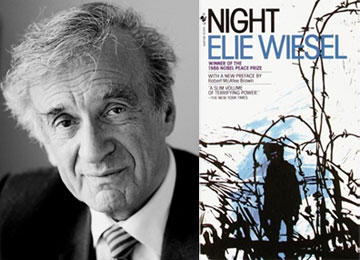
I've read a lot of Holocaust Literature and other books, fiction and nonfiction, centered around the Jewish Holocaust (To See You Again, The Sunflower, Sarah's Key, The Book Thief, and Maus to name a few great ones) but I sadly hadn't read Night, which we all know is so short it can literally be read in an afternoon. So what was I doing with my time and in my classes? Well, for one reading Jane Austen's novels over and over again for numerous different courses.
Even though Night is deemed one of the 'classics of Holocaust Literature,' I found its abrupt ending somewhat unsettling and it just seemed like there was something missing. In the Preface, Wiesel mentions that the book, which "was written in Yiddish as And the World Remained Silent and translated first in French, then into English - was rejected by every major publisher, French and American" (8). He also notes that he made numerous cuts and was told countless times that it was just too long (although most of us know it's fairly short for a memoir/novel, my copy was just 135 pages). Though the version I read was a more recent translation, I sensed that perhaps these cuts might have been extremely important and should have been left in as he would have liked. In the Preface he gives several examples of narrative that was cut when translated into English and these seemed to me the strongest, most reflective of the book. Most likely he included them in the Preface so that they could, in a sense, be included despite publishers' best efforts to keep them out.
Perhaps I've just read so many other narratives about the Holocaust that touched me more (others were written from young women's perspectives, which might have something to do with it?) or maybe I started reading, knowing that there were things missing that he would have liked to have included. Either way it was an honest portrayal of his devastating experience during the Holocaust, but more importantly, as he writes in the Preface:
"In retrospect I must confess that I do not know, or no longer know, what I wanted to achieve with my words. I only know that without this testimony, my life as a writer - or my life, period - would not have become what it is: that of a witness who believes he has a moral obligation to try to prevent the enemy from enjoying one last victory by allowing his crimes to be erased from human memory" (6).
 |
| Source |
More quotes from the Preface . . .
"Painfully aware of my limitations, I watched helplessly as language became an obstacle. It became clear that it would be necessary to invent a new language. But how was one to rehabilitate and transform words betrayed and perverted by the enemy? Hunger - thirst - transport - selection - fire - chimney: these words all have intrinsic meaning, but in those times, they meant something else" (7).
"And so I persevered. And trusted the silence that envelops and transcends words. Knowing all the while that any of the fields of ashes in Birkenau carries more weight than all the testimonies about Birkenau. For, despite all my attempts to articulate the unspeakable, 'it' is still not right" (8).
"To forget would be not only dangerous but offensive; to forget the dead would be akin to killing them a second time" (13).
"Sometimes I am asked if I know 'the response to Auschwitz;' I answer that not only do I not know it, but that I don't even know if a tragedy of this magnitude has a response. What I do know is that there is 'response' in responsibility. When we speak of this era of evil and darkness, so close and yet so distant, 'reponsibility' is the key word. The witness has forced himself to testify. For the youth of today, for the children who will be born tomorrow. He does not want his past to become their future" (13).


The quote from page seven made me think of Oskar's grandfather. It is so powerful that after Dresden he lost language. In Martin Buber's book I & Thou he says that when one speaks the word I they also speak You and vice versa. I first read that when reading ELIC. I wrote in the margins, "thus when Oskar's grandfather lost I, he also lost you." That doesn't exactly relate to this but it reminded me of it.
ReplyDeleteFrom all these quotes I feel like I want to at least read his Preface, if not his book.
How his book seems in someways a failure reminds me of Slaughterhouse-Five. Vonnegut said he had to write it, he had to write about Dresden, and yet he felt the book was a failure. That it had to be because it was written by a pillar of salt. He like Lot's wife couldn't help but look back. The failure of Vonnegut's book is also it's success though because it so highlights the senseless, hollow destructiveness of war. It strips war of romanticism. It sounds like Night strips the Holocaust of the tragic yet romantic way in which we can view it.
I can tell that ELIC really stuck with you in a way that it just hasn't with me, but I think sometimes it all depends on when we read certain books. Sometimes we might read a book at one point (or start one unsuccessfully) and it doesn't many anything to us because of the things we're going through. Another time it might mean the world to us! Just a thought...
ReplyDeleteI think you should definitely read his preface..I could probably even scan it and send it to you if you'd like because it's not very long. And you'll notice I only took quotes from the Preface because I thought it was the best part. I kind of wish he'd keep writing that way, or at least break free from the publishers who aren't letting him keep the stuff he wants - seems like he'd be able to do whatever he wants now!
I don't know much at all about Vonnegut but it does sound similar to Weisel. And there is definitely no romanticism in this book, although I haven't read a Holocaust novel that is. But I would say that it is tragic, in an almost hopeless way, hopeless in ways other books I've read haven't been...I don't know... I just really suggest you read it though...the ending is still baffling to me. It's like he just got tired of writing and sat down his pen, never wrapping things up or reflecting...that's just me though. I think a lot of it might have to do with the faith that he had and (maybe?) lost. That part is very vague and I'm still not sure whether he has faith now or not. Scott teaches his play to his freshmen religion classes and I asked him and he wasn't sure either. Faithlessness often leads to hopelessness and I think that's just how I felt at the end.
But the book I have is part of a trilogy - he wrote two novels after this 'memoir' called Dawn and Day so maybe those might be helpful in wrapping my head around the strange ending.